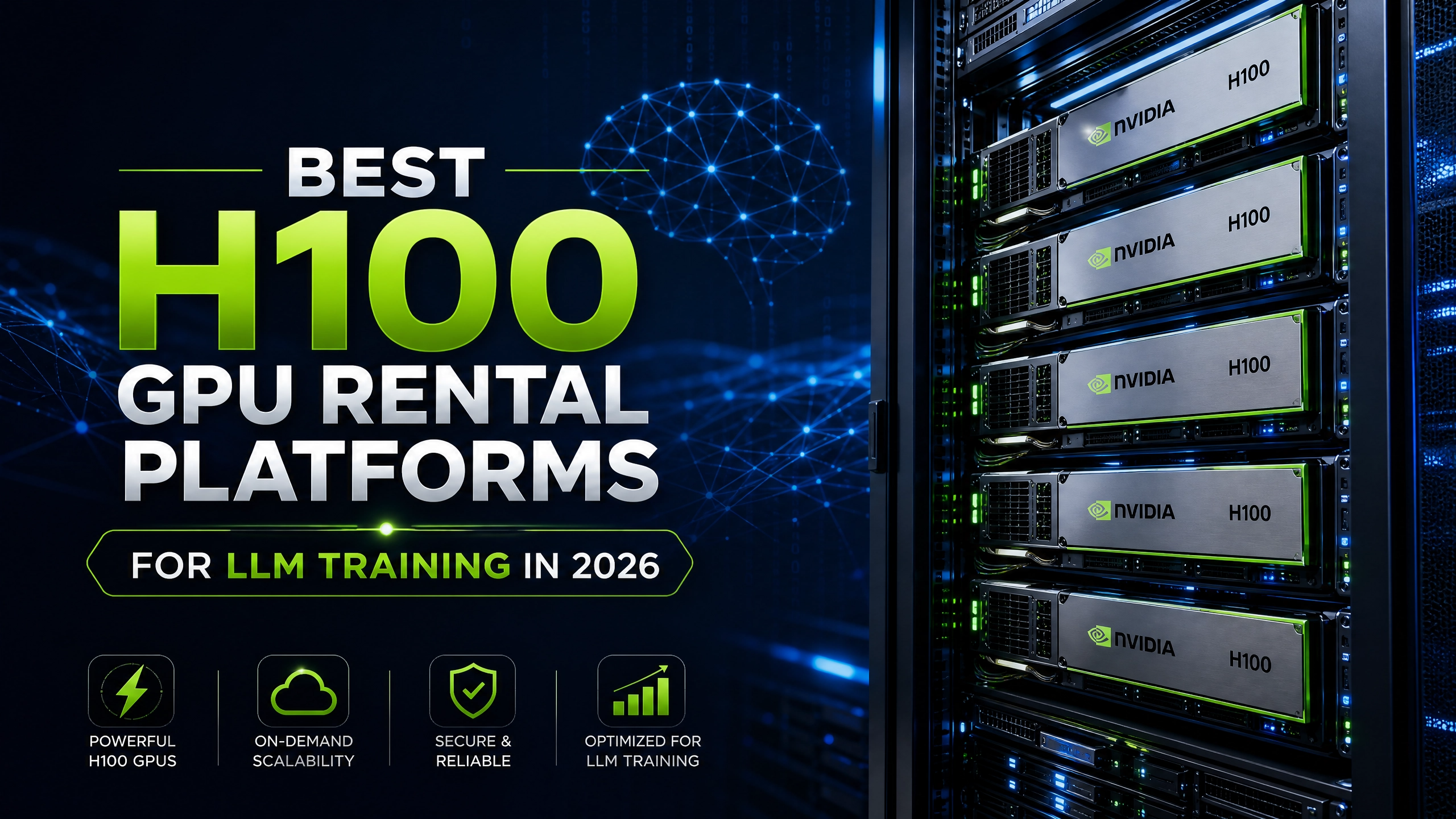
Compare the best H100 GPU rental platforms for LLM training, fine-tuning, and AI workloads in 2026. Explore pricing, performance, scalability, and cost-effective alternatives to traditional cloud providers to find the right infrastructure for your AI projects.
Key Takeaways
- NVIDIA H100 GPUs remain one of the most powerful and widely used options for LLM training, fine-tuning, and large-scale AI inference workloads.
- Specialized AI clouds and decentralized GPU marketplaces are helping startups and developers access H100 infrastructure without the costs and complexity of traditional hyperscalers.
- The best H100 GPU rental platform depends on factors such as pricing, scalability, deployment speed, support, and distributed training capabilities.
- Platforms including CapaCloud, CoreWeave, RunPod, Lambda Labs, Vast.ai, AWS, Google Cloud, and Azure each offer distinct advantages depending on your use case.
- Understanding the full cost of GPU infrastructure, including storage, networking, and data transfer fees, can help AI teams reduce overall training expenses.
Training large language models has become increasingly compute-intensive, driving demand for high-performance GPUs such as the NVIDIA H100. From fine-tuning open-source models to training custom AI systems, organizations need infrastructure that can deliver speed, scalability, and efficiency.
The challenge is that H100 GPUs can be expensive and difficult to access through traditional cloud providers, where availability constraints and premium pricing are common. As a result, many startups, researchers, and enterprise teams are turning to specialized AI clouds and decentralized GPU marketplaces for more flexible and cost-effective access to H100 infrastructure.
In this guide, we’ll compare the best H100 GPU rental platforms in 2026, explore their strengths and limitations, and help you choose the right provider for your AI workloads.
Why H100 GPUs Are Important for LLM Training
As large language models continue to grow in size and complexity, the infrastructure required to train and deploy them has become increasingly demanding. Training modern AI models involves processing massive datasets, managing billions of parameters, and running computations across multiple GPUs simultaneously.
This is where NVIDIA H100 GPUs stand out.
Built specifically for AI and high-performance computing workloads, the H100 has become the preferred choice for many organizations developing, fine-tuning, and deploying large language models. Compared to previous-generation hardware, it delivers significant improvements in speed, efficiency, and scalability, helping teams train models faster while making better use of available resources.
Key Advantages of NVIDIA H100 GPUs
The H100 was designed to address many of the performance bottlenecks associated with modern AI workloads. Its advanced architecture enables organizations to process larger datasets, reduce training times, and support increasingly sophisticated AI applications.
Key advantages include:
- 80GB of high-speed HBM3 memory
- Transformer Engine acceleration optimized for AI workloads
- Increased memory bandwidth for faster data processing
- Higher training and inference throughput
- Improved energy efficiency compared to previous generations
- Strong support for multi-GPU and distributed computing environments
These capabilities make the H100 particularly effective for training large transformer models and running demanding AI workloads at scale.
What Workloads Actually Need H100 GPUs?
While H100 GPUs deliver exceptional performance, not every machine learning project requires this level of computing power. Smaller models, traditional machine learning applications, and lightweight inference workloads can often run effectively on lower-cost GPUs.
However, H100 GPUs become increasingly valuable for more demanding use cases, including:
- Fine-tuning open-source large language models
- Training multi-billion parameter AI models
- Large-scale inference and production AI applications
- Retrieval-augmented generation (RAG) systems
- Multi-GPU distributed training workloads
- Enterprise AI applications requiring low latency and high throughput
For organizations building advanced AI products, the H100 often provides the performance and scalability needed to accelerate development while maintaining operational efficiency.
As a result, it has become one of the most sought-after GPUs in the AI infrastructure market and a critical component of many modern machine learning workflows.
H100 vs A100 vs H200: Which GPU Is Right for AI Training?
When choosing a GPU rental platform, it is important to understand how the NVIDIA H100 compares to both the previous-generation A100 and the newer H200. While all three GPUs are capable of handling AI workloads, they are designed for different performance requirements, budgets, and deployment scenarios.
For most organizations, the decision comes down to balancing performance, memory capacity, availability, and cost.
H100 vs A100
The NVIDIA A100 helped power the first wave of large-scale AI development and remains a reliable option for many machine learning workloads. It continues to be widely available across cloud providers and is often a cost-effective choice for smaller training jobs.
However, the H100 delivers substantial improvements that make it better suited for modern AI workloads, particularly transformer-based models and large language models.
Key advantages of the H100 include:
- Faster training and inference performance
- Higher memory bandwidth
- Transformer Engine acceleration for AI workloads
- Improved energy efficiency
- Better scalability for multi-GPU training
For teams training or fine-tuning LLMs, the performance gains offered by the H100 can significantly reduce training times and improve overall productivity.
H100 vs H200
The H200 is NVIDIA’s next-generation GPU built on the H100 architecture. Its biggest advantage is increased memory capacity, which makes it particularly attractive for training larger models and handling long-context AI workloads.
Benefits of the H200 include:
- Larger memory footprint
- Improved performance for memory-intensive workloads
- Better support for extremely large models
- Enhanced capabilities for long-context inference and training
While the H200 offers impressive performance, it also comes with higher pricing and more limited availability compared to the H100. For many organizations, those tradeoffs may outweigh the additional benefits.
Why Many AI Teams Still Choose H100
Despite the arrival of newer hardware, the H100 remains one of the most popular GPUs for AI development in 2026. It offers a strong combination of performance, availability, and cost efficiency that meets the needs of most AI teams.
Many organizations continue to choose the H100 because it provides:
- Broad availability across cloud providers
- Mature software and framework support
- Excellent performance for training and inference
- Strong support for distributed workloads
- Better pricing than newer-generation alternatives
For startups, researchers, and enterprise teams alike, the H100 often represents the sweet spot between affordability and performance, making it one of the best GPU options for modern AI workloads.
Why Decentralized GPU Clouds Are Growing
The rapid growth of artificial intelligence has created unprecedented demand for high-performance computing infrastructure. As more organizations train, fine-tune, and deploy AI models, access to powerful GPUs has become one of the biggest challenges facing the industry.
While traditional cloud providers remain important players in the market, many AI teams are exploring alternative ways to access GPU resources. Decentralized GPU clouds and marketplace-based platforms are emerging as attractive options for startups, researchers, and organizations looking for greater flexibility and cost efficiency.
The Problem with Traditional Cloud GPU Access
Major cloud providers offer access to advanced GPUs such as the NVIDIA H100, but securing those resources is not always straightforward.
Many AI teams face challenges including:
- Limited GPU availability during periods of high demand
- Premium hourly pricing for high-performance hardware
- Long procurement and approval processes
- Capacity restrictions for larger deployments
- Unexpected infrastructure costs beyond compute usage
For startups and fast-moving development teams, these obstacles can slow experimentation, delay product development, and increase overall infrastructure spending.
How Decentralized GPU Marketplaces Work
Decentralized GPU marketplaces take a different approach. Instead of relying on a single cloud provider, they connect organizations with a network of independent infrastructure providers that have available GPU capacity.
Through a centralized platform, users can discover, compare, and deploy GPU resources from multiple providers, often within minutes.
This model offers several advantages:
- More competitive pricing through marketplace competition
- Faster access to available GPU resources
- Greater infrastructure flexibility
- Access to a broader pool of hardware
- Reduced dependence on a single vendor
By unlocking underutilized GPU capacity across the market, decentralized platforms help make advanced AI infrastructure more accessible to a wider range of users.
Why Startups and Researchers Are Using Them
For many startups and research teams, speed and flexibility are just as important as raw computing power.
Decentralized GPU platforms allow organizations to scale resources up or down based on project requirements without committing to long-term contracts or significant upfront investments.
Common benefits include:
- Lower infrastructure costs
- Flexible pay-as-you-go pricing
- Short-term access to enterprise-grade GPUs
- Faster experimentation and model iteration
- Easier access to specialized hardware such as H100 GPUs
As AI development becomes increasingly competitive, the ability to access powerful computing resources quickly and cost-effectively can provide a meaningful advantage. This is one of the main reasons decentralized GPU marketplaces are becoming an increasingly important part of the AI infrastructure ecosystem.
Key Things to Compare Before Renting H100 GPUs
Not all GPU platforms offer the same experience.
Before choosing a provider, consider the following factors.
Pricing Models
Different providers use different billing approaches, including:
- Hourly pricing
- Reserved capacity discounts
- Spot instances
- Subscription-based models
Comparing hourly rates alone may not provide a complete picture of total costs.
Availability and Scalability
As projects grow, infrastructure requirements often change.
Consider:
- Single-GPU deployments
- Multi-GPU support
- Multi-node deployments
- Provisioning speed
- Regional availability
The ability to scale efficiently can become a major advantage as workloads increase.
Performance and Reliability
Infrastructure quality can vary significantly between providers.
Important considerations include:
- Uptime
- Network performance
- Storage throughput
- Infrastructure consistency
- Technical support availability
Reliable infrastructure helps prevent costly disruptions.
Ease of Use
Developer experience also matters.
Look for support for:
- Docker containers
- Kubernetes deployments
- Jupyter notebooks
- APIs and CLI tools
- PyTorch, TensorFlow, and JAX
Simple deployment workflows can help teams move from experimentation to production more quickly.
H100 GPU Rental Platform Comparison
| Platform | Pricing Transparency | Best For |
| CapaCloud | High | Startups and AI teams |
| CoreWeave | Moderate | Enterprise AI workloads |
| Lambda Labs | High | Researchers and developers |
| RunPod | High | Fast experimentation |
| Vast.ai | High | Cost-conscious users |
| AWS | Moderate | Enterprise deployments |
| Google Cloud | Moderate | Distributed training |
| Azure | Moderate | Compliance-focused organizations |
Best H100 GPU Rental Platforms
CapaCloud
CapaCloud is a decentralized GPU marketplace that provides access to H100 infrastructure through a network of distributed compute providers. The platform is designed to help AI teams access scalable GPU resources without the complexity often associated with traditional cloud procurement.
Best for: Startups, researchers, and cost-conscious AI teams
Key strengths:
- Access to H100 GPU infrastructure
- Flexible marketplace-based pricing
- Fast deployment options
- Scalable infrastructure for AI workloads
Potential limitation: Availability may vary depending on marketplace supply.
AWS EC2 P5 Instances
AWS offers H100 GPUs through its P5 instance family, providing enterprise-grade infrastructure for large-scale AI training and inference. Organizations already using AWS can benefit from seamless integration with its broader cloud ecosystem.
Best for: Enterprise AI deployments
Key strengths:
- Global infrastructure footprint
- Extensive cloud services ecosystem
- Strong security and compliance capabilities
- Mature AI and machine learning tools
Potential limitation: Pricing is often higher than that of many AI-focused alternatives.
Google Cloud A3 Instances
Google Cloud’s A3 instances provide H100-powered infrastructure designed for machine learning and distributed training workloads. The platform integrates closely with Google’s AI and data services.
Best for: Distributed AI training and Google Cloud users
Key strengths:
- Vertex AI integration
- High-performance networking
- Strong support for large-scale AI workloads
- Advanced machine learning tooling
Potential limitation: Costs can increase quickly for large training jobs.
Microsoft Azure ND H100 v5
Azure’s ND H100 v5 instances are designed for demanding AI workloads while supporting enterprise governance and compliance requirements. The platform is particularly attractive to organizations operating in regulated industries.
Best for: Compliance-focused enterprise teams
Key strengths:
- Enterprise security controls
- Hybrid cloud capabilities
- Strong governance features
- Global cloud infrastructure
Potential limitation: Deployment complexity can be higher for smaller teams.
CoreWeave
CoreWeave is an AI-focused cloud provider that specializes in GPU infrastructure for machine learning workloads. It has become a popular option for organizations requiring high-performance compute resources at scale.
Best for: Large-scale AI training
Key strengths:
- AI-optimized infrastructure
- High-performance networking
- Scalable GPU clusters
- Strong support for training workloads
Potential limitation: More focused on larger deployments than small experimental projects.
Lambda Labs
Lambda Labs provides GPU cloud infrastructure built specifically for developers, researchers, and AI startups. The platform emphasizes simplicity and transparent pricing.
Best for: Researchers and AI developers
Key strengths:
- Developer-friendly platform
- Transparent pricing
- Easy deployment workflows
- Strong AI community adoption
Potential limitation: Fewer enterprise services than hyperscale cloud providers.
RunPod
RunPod offers flexible GPU rentals with a focus on simplicity and affordability. The platform is widely used for model fine-tuning, inference, and experimentation.
Best for: AI experimentation and fine-tuning
Key strengths:
- Fast provisioning
- Competitive pricing
- User-friendly workflows
- Flexible deployment options
Potential limitation: Enterprise support options may be more limited than larger cloud providers.
Vast.ai
Vast.ai is one of the largest decentralized GPU marketplaces available today. The platform connects users with a wide range of independent GPU providers, offering access to competitive pricing and diverse hardware options.
Best for: Cost-conscious AI teams
Key strengths:
- Extensive hardware availability
- Competitive marketplace pricing
- Flexible rental durations
- Wide provider network
Potential limitation: Infrastructure consistency can vary between providers.
Best Platforms for Different Use Cases
| Use Case | Recommended Platforms | Why They Stand Out |
| AI Startups | CapaCloud, RunPod, Vast.ai | Flexible pricing, fast deployment, and lower infrastructure costs make these platforms ideal for startups that need to experiment and scale efficiently. |
| Enterprise AI Teams | AWS, Azure, CoreWeave | Strong security, compliance capabilities, enterprise support, and reliable infrastructure for production AI workloads. |
| Research and Fine-Tuning | Lambda Labs, RunPod, CapaCloud | Developer-friendly environments, transparent pricing, and easy access to high-performance GPUs for experimentation and model optimization. |
| Large-Scale Distributed Training | CoreWeave, Google Cloud, AWS | Advanced networking, multi-node support, and infrastructure designed for demanding distributed training workloads. |
| Cost-Conscious AI Teams | CapaCloud, Vast.ai, RunPod | Marketplace-based pricing and flexible deployment options help reduce overall GPU infrastructure costs. |
| LLM Inference and Production Deployment | CoreWeave, Google Cloud, Azure | High availability, scalable infrastructure, and strong support for production AI applications with demanding performance requirements. |
| Short-Term GPU Projects | RunPod, Vast.ai, CapaCloud | Pay-as-you-go pricing and rapid provisioning make these platforms suitable for temporary workloads and proof-of-concept projects. |
| Compliance and Regulated Industries | Azure, AWS | Enterprise-grade governance, security controls, and compliance certifications for organizations operating in regulated sectors. |
While no single provider is the best fit for every workload, understanding your performance requirements, budget, and scalability needs can help narrow down the most suitable platform for your AI projects.
H100 GPU Pricing Comparison and Cost Optimization
H100 pricing varies considerably depending on the provider, deployment model, and infrastructure configuration.
Traditional cloud providers often command premium pricing, while specialized AI clouds and decentralized marketplaces may offer more competitive alternatives.
Hidden Costs to Watch For
When estimating infrastructure expenses, remember to consider:
- Data transfer fees
- Storage costs
- Networking charges
- Idle compute resources
These costs can significantly affect total monthly spending.
Ways to Reduce H100 GPU Costs
Organizations can improve efficiency by:
- Using spot instances where appropriate
- Shutting down idle resources
- Optimizing training workflows
- Keeping data close to compute resources
- Comparing multiple infrastructure providers
Small improvements in resource utilization can generate meaningful savings over time.
How to Choose the Right H100 GPU Rental Platform
There is no single best H100 rental platform for every organization.
The ideal choice depends on your goals.
Choose traditional cloud providers if you need extensive compliance controls, enterprise integrations, and mature support systems.
Choose specialized AI cloud providers if you want infrastructure specifically optimized for machine learning workloads.
Choose decentralized GPU marketplaces if your priorities include flexibility, cost efficiency, and rapid access to GPU resources.
Understanding your workload requirements, budget, and scalability needs will help you make the best decision.
FAQs
What is the cheapest way to rent H100 GPUs?
The most affordable option often depends on availability and workload requirements, but decentralized GPU marketplaces and specialized AI cloud providers typically offer more competitive pricing than traditional hyperscale cloud platforms. These platforms can help organizations access H100 infrastructure without committing to expensive long-term contracts.
How many H100 GPUs do I need for LLM training?
The number of GPUs required depends on factors such as model size, dataset volume, batch size, and training objectives. Smaller fine-tuning projects may run efficiently on a single H100, while training larger models often requires multiple GPUs working together in a distributed environment.
Is renting H100 GPUs cheaper than buying them?
For many organizations, yes. Purchasing H100 hardware requires a significant upfront investment and ongoing maintenance costs. Renting allows teams to access enterprise-grade infrastructure on demand, scale resources as needed, and avoid the financial burden of owning hardware.
Are H100 GPUs good for inference workloads?
Absolutely. While H100 GPUs are widely known for accelerating AI training, they also excel at inference. Their high memory bandwidth and optimized architecture make them well suited for serving large language models and other production AI applications that require low latency and high throughput.
Can I rent multiple H100 GPUs for distributed training?
Yes. Most major cloud providers and AI-focused GPU platforms support multi-GPU and multi-node deployments. This allows organizations to distribute workloads across several H100 GPUs, reducing training times for larger and more complex models.
Is the H100 significantly better than the A100 for AI training?
For many modern AI workloads, the answer is yes. The H100 offers faster training performance, higher memory bandwidth, improved efficiency, and dedicated Transformer Engine capabilities that accelerate large language model training and inference. These advantages can translate into shorter training cycles and lower overall infrastructure costs.
What should I look for when choosing an H100 GPU rental platform?
Pricing is important, but it should not be the only consideration. Organizations should also evaluate GPU availability, deployment speed, scalability, networking performance, support quality, and compatibility with frameworks such as PyTorch, TensorFlow, and JAX.
Are decentralized GPU marketplaces reliable for AI workloads?
Many decentralized GPU marketplaces have matured significantly and now provide reliable access to enterprise-grade hardware. They are particularly attractive for startups, researchers, and development teams looking for flexible and cost-effective GPU infrastructure. However, organizations with strict compliance or service-level requirements may still prefer traditional enterprise cloud providers.
Conclusion
H100 GPUs have become essential infrastructure for modern AI development. From startup experimentation and model fine-tuning to enterprise-scale training workloads, they provide the performance required to build increasingly sophisticated AI systems.
The right platform depends on your budget, workload requirements, scalability goals, and operational priorities. While traditional cloud providers continue to serve enterprise organizations, specialized AI clouds and decentralized GPU marketplaces are creating new opportunities for startups and researchers to access high-performance infrastructure more efficiently.
As demand for AI compute continues to grow, organizations that carefully evaluate their GPU infrastructure options will be better positioned to scale AI initiatives while controlling costs.
Looking for flexible and cost-effective H100 GPU rentals for your AI workloads? Explore CapaCloud‘s decentralized GPU marketplace to access scalable H100 infrastructure, transparent pricing, and fast deployment for training, fine-tuning, and inference workloads.