Explore Capacloud, a carbon neutral cloud alternative to Amazon Web Services. Run AI workloads on sustainable GPU infrastructure with lower costs, transparent carbon tracking, and scalable decentralized compute.
Key takeaways
- Capacloud provides a carbon neutral alternative to Amazon Web Services by using decentralized GPU infrastructure instead of energy intensive data centers.
- Its distributed model improves efficiency by utilizing idle global compute resources and aligning workloads with renewable energy sources.
- Developers benefit from simplified workflows, elastic scaling, and market driven pricing that can reduce costs compared to traditional cloud platforms.
- Transparent carbon tracking aligned with frameworks like the Greenhouse Gas Protocol makes it easier for organizations to measure and report emissions.
- Capacloud is positioned for the future of AI and sustainable computing, offering a scalable solution that balances performance, cost, and environmental responsibility.
Cloud computing has quietly become the backbone of the modern economy. From early stage startups to global enterprises, nearly every digital product today relies on scalable infrastructure delivered through platforms like Amazon Web Services. This convenience has enabled rapid innovation, faster deployments, and global accessibility.
However, that convenience comes at a cost that is often overlooked.
Behind every API call, model inference, or data pipeline is a physical layer of infrastructure powered by massive data centers. These facilities run 24 hours a day and require enormous amounts of electricity, not only to power servers but also to cool them. While progress has been made toward renewable energy, a significant portion of global cloud infrastructure still depends on energy grids that include fossil fuels.
The problem is intensifying with the rise of artificial intelligence.
Modern AI workloads are far more demanding than traditional applications. Training large models can require thousands of GPU hours, and even inference at scale adds continuous pressure on compute resources. This surge in demand is pushing cloud providers to expand capacity, often increasing their overall energy footprint in the process.
As a result, sustainability is no longer a secondary concern. It is becoming a core factor in infrastructure decisions. Companies are now being evaluated not just on performance and cost, but also on how responsibly they operate from an environmental standpoint.
This is where Capacloud introduces a different approach.
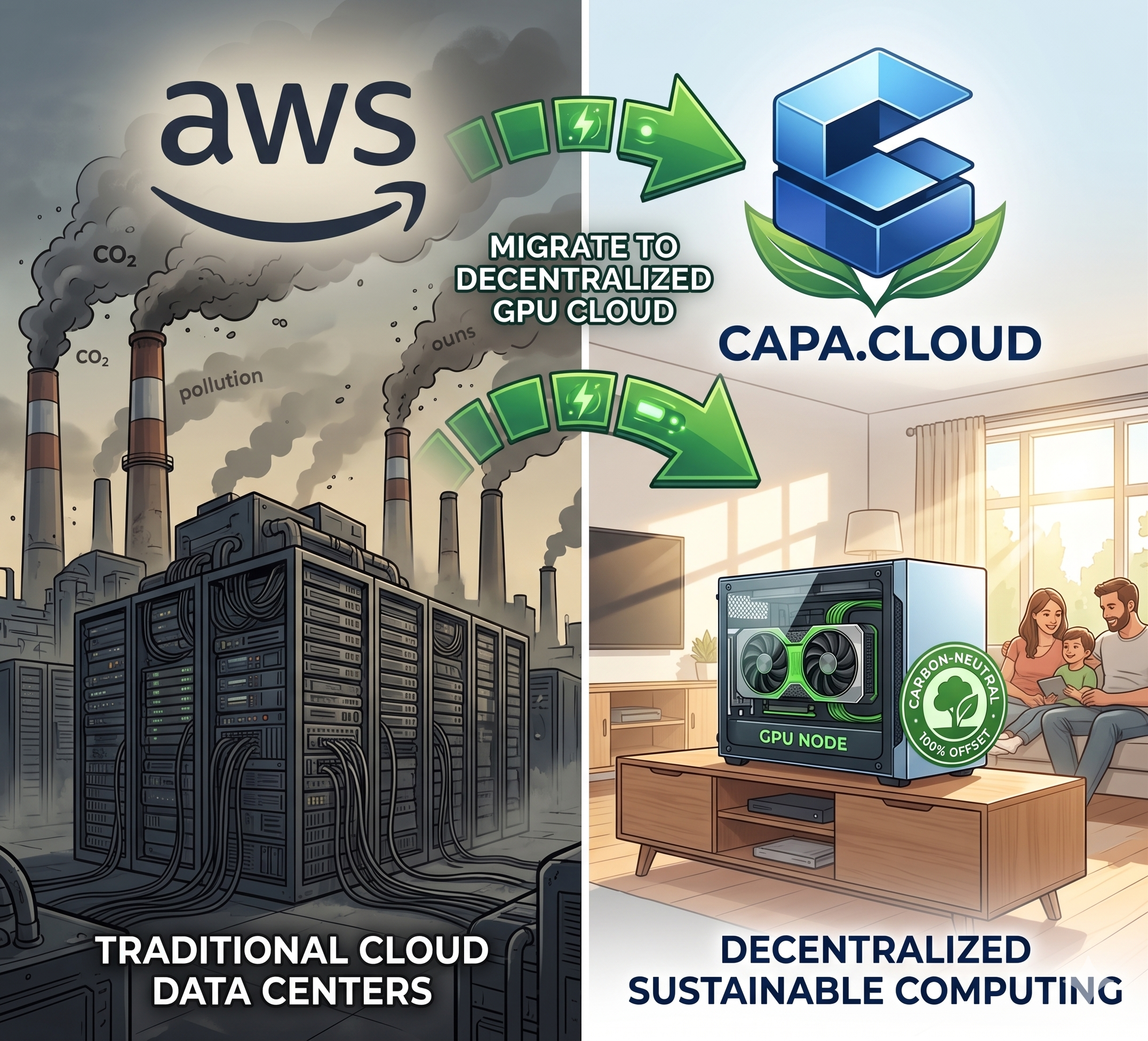
Instead of relying on centralized, energy intensive data centers, Capacloud is built on a decentralized model that taps into underutilized compute resources across the globe. By distributing workloads and aligning them with more efficient and often cleaner energy sources, it reduces the need for new infrastructure while improving overall utilization.
The result is a cloud platform designed with sustainability in mind from the start, without compromising the performance, scalability, and flexibility that developers expect from modern compute environments.
What Is the Best Carbon Neutral Cloud Alternative to AWS?
Capacloud stands out as a carbon neutral cloud alternative to Amazon Web Services by rethinking how cloud infrastructure is built and operated. Instead of relying on large, centralized data centers, it uses a decentralized network of GPU providers powered, in many cases, by cleaner energy sources. This approach reduces overall energy waste while maintaining the scalability required for modern workloads.
What makes Capacloud different is not just the goal of carbon neutrality, but how it is achieved.
Traditional cloud platforms are designed around massive infrastructure hubs. Even when they invest in renewable energy, the system itself still encourages overprovisioning and idle capacity. That means energy is often consumed whether resources are fully utilized or not.
Capacloud takes a more efficient path.
By tapping into underutilized GPUs across a distributed network, it ensures that compute resources are used more effectively. Workloads are matched dynamically to available nodes, which reduces idle time and lowers the energy required per task. This alone can significantly cut down the carbon footprint of compute operations.
Another key advantage is renewable alignment.
Because the network is geographically distributed, workloads can be routed to regions where cleaner energy is available. Instead of being locked into a single data center’s energy mix, users benefit from a more flexible and often greener compute layer.
Transparency is also a major differentiator.
Capacloud provides clearer insight into the carbon impact of workloads, helping developers and organizations understand what their compute actually costs in environmental terms. This is becoming increasingly important as businesses face pressure to meet sustainability targets and report emissions accurately.
Finally, Capacloud is built with AI and high performance workloads in mind.
GPU intensive tasks such as model training and inference are supported through a scalable, on demand network that does not require long term provisioning or complex infrastructure management. Developers can access compute when they need it, without contributing to the same level of persistent energy consumption seen in traditional cloud setups.
In simple terms, Capacloud is not just an alternative to AWS. It represents a shift toward a more efficient, transparent, and environmentally responsible way of running cloud infrastructure.
What Is a Carbon Neutral Cloud
A carbon neutral cloud is a type of computing infrastructure that achieves net zero carbon emissions across its operations. It does this by combining three core elements: efficient resource utilization, the use of renewable energy, and transparent carbon offsetting for any remaining emissions that cannot be eliminated.
At a high level, the goal is simple. For every unit of carbon emitted during compute operations, an equivalent amount is reduced, avoided, or offset so that the net impact is zero. In practice, how this is achieved varies significantly between providers.
There are two key approaches:
- True carbon neutral infrastructure reduces emissions at the source
- Offset based systems compensate after emissions occur
Capacloud focuses on reducing emissions first, then handling any remaining footprint transparently.
The Problem with Traditional Cloud Providers
Traditional providers like Amazon Web Services, Microsoft Azure, and Google Cloud Platform have built powerful platforms, but their structure creates limitations.
- Energy Consumption: Centralized data centers require constant power for compute and cooling.
- Carbon Footprint: Even with renewable commitments, energy sourcing is not always clean in practice.
- Limited Transparency: Carbon reporting is often aggregated and difficult to audit independently.
- Cost and Lock In: Pricing is fixed and ecosystems are tightly controlled, making switching difficult.
Introducing Capacloud
Capacloud is a decentralized cloud platform built specifically for sustainable GPU computing. It reimagines how cloud infrastructure is sourced, allocated, and scaled by shifting away from centralized ownership toward a distributed network of independent compute providers.
At its core, Capacloud is not just another cloud service. It is a coordination layer that connects developers who need compute with providers who have available GPU capacity. This creates a more flexible, efficient, and environmentally responsible system for running modern workloads, especially in AI and machine learning.
What Makes It Different
- Built as a distributed network instead of centralized data centers
- Designed for carbon efficiency from the start
- Open marketplace for compute resources
Instead of owning infrastructure, Capacloud coordinates a global network of compute providers.
How Capacloud Works
Capacloud operates through a coordinated system that connects demand and supply of compute.
Core Components
- Compute Nodes: Independent providers offering GPU resources
- Orchestration Layer: Matches jobs with available resources
- Scheduling Engine: Optimizes workload distribution
- Marketplace Layer: Enables dynamic pricing based on supply and demand
Job Lifecycle
- A developer submits a compute job
- The scheduler identifies suitable nodes
- Workloads are distributed across available GPUs
- Results are validated and returned
This system reduces idle compute and improves overall efficiency.
How Capacloud Achieves Carbon Neutrality
- Distributed Infrastructure: By using existing underutilized GPUs globally, Capacloud avoids building new energy intensive data centers.
- Renewable Energy Alignment: Nodes can operate in regions powered by solar, wind, or hydro energy.
- Carbon Tracking and Verification: Capacloud introduces transparent accounting aligned with standards like the Greenhouse Gas Protocol.
This allows users to understand the carbon impact of their workloads.
Carbon Impact Comparison
While exact numbers vary by workload, the structural difference is clear:
- Centralized cloud concentrates energy consumption in large facilities
- Capacloud distributes workloads to reduce waste and tap into cleaner energy sources
Example scenario:
- Training workloads on traditional cloud may result in high indirect emissions due to energy mix
- Distributed execution on renewable powered nodes can significantly reduce total emissions
As regulatory frameworks like the Science Based Targets initiative gain adoption, this level of transparency becomes essential.
Sustainable GPU Infrastructure
GPU workloads are one of the biggest drivers of cloud energy usage.
The Challenge
- Large AI models require thousands of GPU hours
- Many GPUs sit idle in traditional setups
Capacloud Approach
- Dynamic allocation of workloads across global nodes
- Better utilization of existing hardware
- Reduced need for new infrastructure
This leads to lower energy usage per compute task.
Developer Workflow Example
Here is what using Capacloud looks like in practice.
Train an AI Model
- Upload your dataset
- Select GPU requirements
- Submit the training job
- The network distributes the workload
- Retrieve trained model outputs
Compared to traditional cloud, this removes the need to manage regions, instances, and scaling manually.
Key Features of Capacloud
- Decentralized GPU marketplace
- Elastic scaling based on demand
- Pay as you go pricing
- Transparent resource tracking
- Global compute access
How Pricing Works
Capacloud uses a market driven model.
Key Factors
- GPU availability
- Demand for compute
- Node provider pricing
This creates:
- Competitive pricing
- Lower cost compared to fixed cloud rates
- Incentives for providers to contribute resources
It also introduces the concept of compute liquidity, where unused GPU capacity becomes available to others.
Capacloud vs AWS
| Feature | Capacloud | AWS |
| Architecture | Distributed | Centralized |
| Carbon Model | Built in neutrality | Offset heavy |
| Pricing | Market driven | Fixed pricing |
| GPU Access | Global pool | Region based |
| Transparency | Auditable | Limited |
| Dev Experience | Simplified job submission | Complex setup |
| Scalability | Elastic via network | Region constrained |
Use Cases
- AI and Machine Learning: Model training, inference, and experimentation.
- Web3 Infrastructure: Decentralized applications and compute heavy protocols.
- Research: Simulations and large scale data analysis.
- Startups: Affordable access to GPU resources without upfront investment.
- Enterprise ESG Initiatives: Organizations aiming to reduce emissions and meet sustainability goals.
Enterprise ESG and Compliance Benefits
Capacloud supports organizations looking to align with sustainability frameworks.
Key Benefits
- Reduced Scope 2 emissions
- Transparent reporting
- Support for disclosures aligned with frameworks like the Task Force on Climate-related Financial Disclosures
This helps companies meet both internal goals and external regulatory expectations.
Myths vs Reality
Myth: Decentralized cloud is unreliable
Reality: Redundancy across nodes improves resilience.
Myth: Performance is always worse
Reality: Optimized scheduling can match or exceed traditional setups for many workloads.
Myth: It is not enterprise ready
Reality: Rapid improvements in orchestration and monitoring are closing the gap.
Challenges and Considerations
- Performance can vary depending on node quality
- Latency requires thoughtful workload design
- Ecosystem is still maturing compared to traditional providers
These are real considerations, but they are being actively addressed.
Future of Sustainable Cloud Computing
The direction is clear.
- AI demand will continue to grow
- Carbon accountability will become mandatory
- Distributed infrastructure will gain traction
Capacloud sits at the intersection of these trends.
Conclusion
Cloud computing is entering a new phase where sustainability is becoming just as important as performance and cost. As AI and other compute intensive workloads continue to grow, so does the energy required to support them. This has made environmental impact a key consideration for businesses, not just a secondary concern.
Capacloud presents a practical alternative to traditional providers like Amazon Web Services by changing how cloud infrastructure is structured. Instead of relying on centralized data centers, it uses a decentralized network of compute resources that improves efficiency and reduces wasted energy. Its carbon conscious design ensures that emissions are addressed at the infrastructure level, not just offset after the fact.
This approach allows developers and organizations to scale their workloads without increasing their environmental footprint at the same rate as traditional cloud models. As sustainability expectations continue to rise across industries, solutions like Capacloud are becoming increasingly relevant for teams looking to build responsibly while maintaining performance and flexibility.
FAQs
What is a carbon neutral cloud?
A carbon neutral cloud is infrastructure that achieves net zero emissions by reducing energy consumption, using renewable power sources, and offsetting any remaining emissions through verifiable methods.
How is Capacloud different from Amazon Web Services?
Capacloud uses a decentralized network of GPU providers instead of centralized data centers. This improves resource utilization, reduces energy waste, and offers more transparent carbon tracking compared to traditional cloud platforms.
Is Capacloud truly carbon neutral?
Capacloud focuses on reducing emissions at the infrastructure level first through efficient resource use and renewable alignment, then offsets any remaining footprint using verifiable standards such as the Greenhouse Gas Protocol.
Can Capacloud handle AI and machine learning workloads?
Yes. Capacloud is designed for GPU intensive workloads such as model training, inference, and distributed computing, making it suitable for modern AI applications.
Is decentralized cloud as reliable as traditional cloud providers?
Decentralized cloud systems can be highly reliable when properly orchestrated. Capacloud uses distributed nodes and workload scheduling to maintain performance and resilience.
How does pricing compare to AWS?
Capacloud uses a market driven pricing model based on supply and demand. This can often result in lower costs compared to the fixed pricing structure of traditional providers.
Do I need to manage infrastructure manually?
No. Capacloud abstracts infrastructure management by handling scheduling, resource allocation, and scaling, allowing developers to focus on their workloads.
How does Capacloud reduce environmental impact?
It reduces emissions by utilizing idle GPU resources, distributing workloads efficiently, and aligning compute with regions that use cleaner energy sources.
Is Capacloud suitable for enterprises?
Yes. Capacloud supports enterprise use cases, especially for organizations with sustainability goals or ESG reporting requirements, including alignment with frameworks like the Task Force on Climate-related Financial Disclosures.
What are the main challenges of using a decentralized cloud?
Potential challenges include performance variability, latency considerations, and a developing ecosystem. However, these are actively improving as the technology matures.