 CapaCloud blog
Vast.ai Alternative: Why Developers Are Choosing Distributed GPU Networks

Looking for a Vast.ai alternative? Discover why developers are choosing distributed GPU networks for better GPU availability, scalable AI infrastructure, and flexible pricing, and learn how CapaCloud supports modern AI workloads.
TL;DR
- Developers evaluating a Vast.ai alternative should compare GPU availability, scalability, deployment speed, and total infrastructure cost, not just hourly pricing.
- Distributed GPU networks connect compute resources from multiple providers, giving developers access to a broader pool of GPUs.
- As AI projects become more complex, scalable GPU infrastructure is becoming a priority for startups, researchers, and enterprise teams alike.
- The right GPU marketplace should support your workloads today while providing the flexibility to grow as your compute needs increase.
- CapaCloud is a distributed GPU marketplace that provides on-demand GPU resources for AI training, inference, and high-performance computing.
Artificial intelligence is driving unprecedented demand for GPU compute, making it increasingly difficult for developers to find infrastructure that balances availability, performance, and cost. While Vast.ai has become a popular option for renting GPUs on demand, growing AI workloads often require more than affordable compute. As projects move from experimentation to production, developers begin looking for infrastructure that can scale with their needs.
This shift has led many teams to explore distributed GPU networks. By connecting compute resources from multiple providers, these platforms expand GPU availability and give developers more flexibility when running AI and machine learning workloads. In this guide, we’ll examine why developers are searching for a Vast.ai alternative, the factors that matter most when comparing GPU marketplaces, and how CapaCloud‘s distributed GPU marketplace supports modern AI infrastructure.
Why Developers Look for a Vast.ai Alternative
Vast.ai has become a popular choice for developers who want affordable, on-demand GPU compute without committing to long-term cloud contracts. Its marketplace model gives users access to GPUs from independent providers, making it an attractive option for AI experimentation, model training, and high-performance computing. However, as AI projects grow in complexity, many developers begin evaluating alternatives that better align with their evolving infrastructure requirements.
The decision to explore a Vast.ai alternative is often driven by evolving infrastructure needs. As AI workloads grow, developers increasingly prioritize consistent GPU availability, better scalability, and the flexibility to support more demanding projects.
GPU Availability and Resource Constraints
One of the biggest challenges facing AI developers today is GPU availability. Demand for high-performance GPUs has increased significantly as organizations train larger language models, develop generative AI applications, and deploy machine learning models at scale. During periods of high demand, securing the right GPU can become more difficult, potentially slowing development timelines.
When evaluating alternatives, developers often consider:
- Availability of popular GPU models
- Access to compute resources during peak demand
- The ability to provision GPUs when projects require them
- A broader pool of available hardware
For teams working on time-sensitive AI projects, consistent access to GPU resources can be just as important as pricing.
Scaling Beyond Small AI Projects
Many developers begin with relatively small workloads, such as testing models, building prototypes, or running limited experiments. As those projects mature, infrastructure requirements naturally increase. Training larger models, supporting multiple users, or deploying production AI applications often requires an infrastructure that can grow without introducing unnecessary complexity.
Key considerations include:
- Support for larger AI workloads
- Multi-GPU and distributed computing capabilities
- Infrastructure that accommodates future growth
- Flexible resource allocation as demand changes
Platforms that can scale alongside evolving workloads are often better suited for long-term AI development.
More Than Just Hourly Pricing
Hourly GPU pricing is often the first metric developers compare, but it is only one part of the overall value. A lower hourly rate may not translate into lower total costs if limited GPU availability or deployment inefficiencies delay workloads.
When comparing a Vast.ai alternative, developers should evaluate:
- Overall infrastructure reliability
- GPU availability and hardware selection
- Deployment speed
- Scalability for future workloads
- Pricing transparency and cost predictability
Looking beyond hourly pricing helps teams choose infrastructure that supports both current projects and future growth, rather than optimizing for short-term savings alone.
Why Distributed GPU Networks Are Gaining Popularity
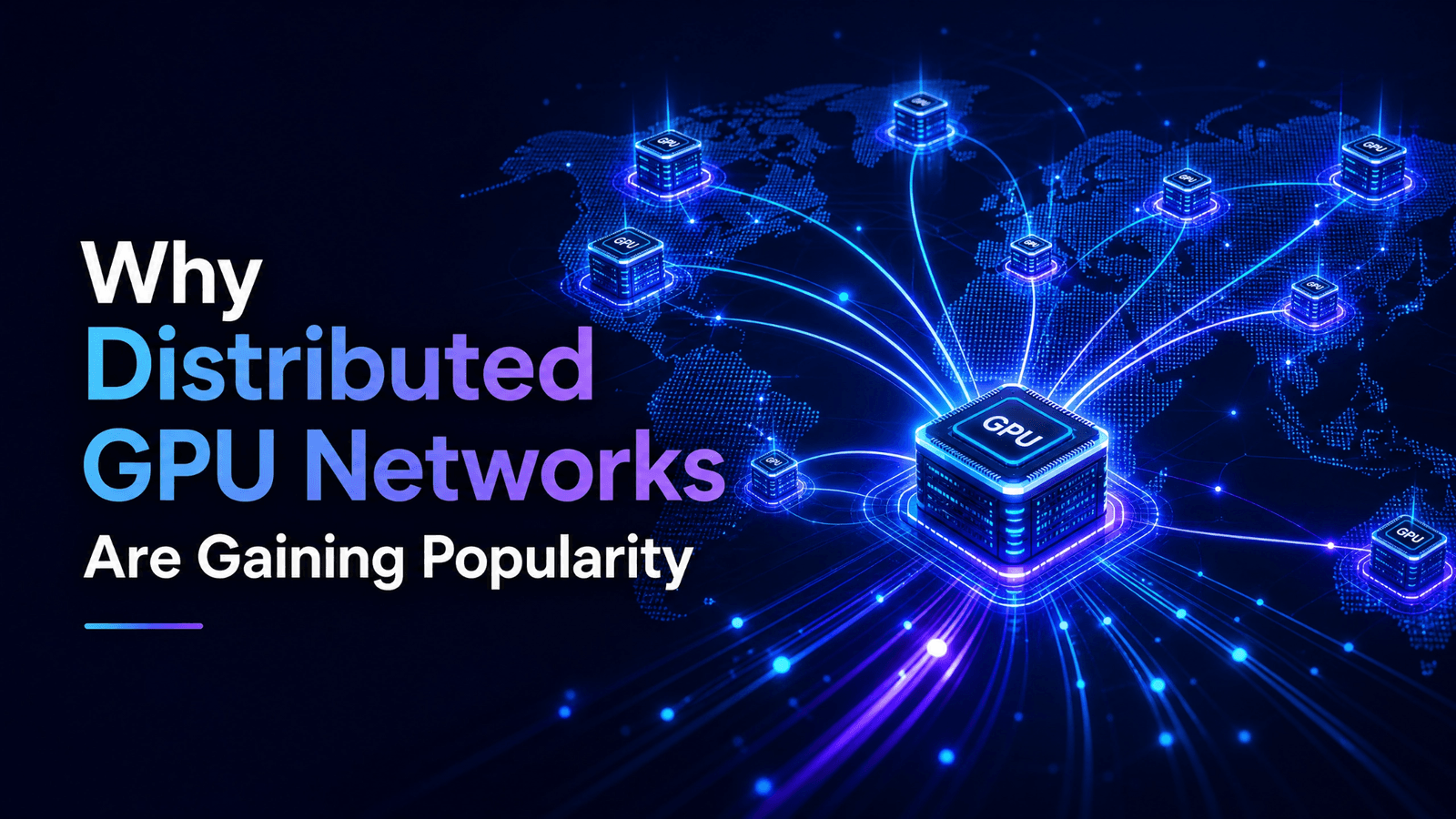
As AI models become larger and more computationally intensive, developers need infrastructure that can adapt to changing demands without sacrificing performance or flexibility. This has contributed to the growing adoption of distributed GPU networks, which connect GPU resources from multiple providers into a single marketplace. Rather than relying on a centralized pool of hardware, distributed networks expand available compute capacity, making it easier for developers to access GPUs when needed.
For AI startups, research teams, and enterprise organizations, this approach offers a more flexible way to source GPU infrastructure while supporting a wide range of machine learning and high-performance computing workloads.
How Distributed GPU Networks Work
Distributed GPU networks aggregate compute resources from independent providers, allowing developers to rent GPUs through a unified marketplace. When a developer launches a workload, the platform matches the job with available GPU resources across the network, giving users access to a broader inventory than a single provider can typically offer.
This marketplace model helps:
- Increase the availability of GPU resources
- Improve utilization of idle GPU capacity
- Provide developers with more hardware options
- Support on-demand AI and machine learning workloads
By making better use of existing GPU infrastructure, distributed networks help address growing demand without relying solely on large centralized data centers.
Key Benefits of Distributed GPU Networks
Developers are increasingly adopting distributed GPU networks because they provide flexibility that aligns with the way modern AI applications are built and deployed.
Some of the key benefits include:
- Broader GPU availability, giving developers access to a wider range of hardware options.
- Flexible scalability, allowing infrastructure to expand as AI workloads become more demanding.
- Marketplace-based pricing, enabling users to compare available resources and choose options that fit their budgets.
- Efficient resource utilization, helping reduce idle GPU capacity while expanding access to compute resources.
These advantages make distributed GPU networks particularly well suited for organizations that need infrastructure capable of supporting everything from rapid experimentation to production-scale AI deployments.
Who Benefits Most?
Distributed GPU networks serve a broad range of users, but they are particularly valuable for teams that require flexible access to high-performance compute.
- AI startups can scale GPU resources without investing in dedicated hardware.
- Machine learning engineers gain on-demand access to GPUs for training, fine-tuning, and inference.
- Research institutions can provision compute resources for large-scale experiments without maintaining extensive GPU clusters.
- Enterprise AI teams can supplement existing infrastructure with additional GPU capacity as workloads increase.
As demand for AI compute continues to grow, distributed GPU networks are becoming an increasingly attractive option for developers seeking infrastructure that is scalable, flexible, and designed to evolve alongside modern AI workloads. CapaCloud follows this model by providing access to distributed GPU resources through a decentralized marketplace, helping developers source the compute capacity they need for AI training, inference, and other high-performance workloads.
When Should You Switch from Vast.ai?
Not every developer needs to move away from Vast.ai. For hobby projects, experimentation, and occasional GPU rentals, it may continue to meet your requirements. However, as AI projects become more sophisticated, it’s worth reassessing whether your current infrastructure can keep pace with your development goals.
Rather than switching because of a single limitation, developers typically evaluate alternatives when their infrastructure needs begin to change.
Your AI Workloads Are Becoming More Demanding
As models grow larger and training datasets increase in size, GPU requirements naturally increase. If you’re regularly training large language models, fine-tuning foundation models, or running multiple AI workloads simultaneously, you’ll benefit from infrastructure that can scale alongside your projects.
You Need More Consistent Access to GPUs
Waiting for the right GPU to become available can delay development and slow experimentation. If GPU availability is becoming a recurring challenge, it may be time to evaluate platforms with access to a broader pool of compute resources.
You’re Planning for Long-Term Growth
Infrastructure decisions shouldn’t only solve today’s challenges. As your team, applications, and AI capabilities expand, your GPU platform should provide the flexibility to support future workloads without requiring frequent changes to your development workflow.
You’re Looking Beyond Price
Hourly pricing is important, but it shouldn’t be the only consideration. Developers increasingly evaluate GPU marketplaces based on factors such as:
- GPU availability
- Deployment speed
- Infrastructure scalability
- Resource flexibility
- Overall developer experience
Choosing a platform that performs well across these areas often delivers greater long-term value than selecting the lowest-priced option.
Vast.ai vs CapaCloud: Key Differences
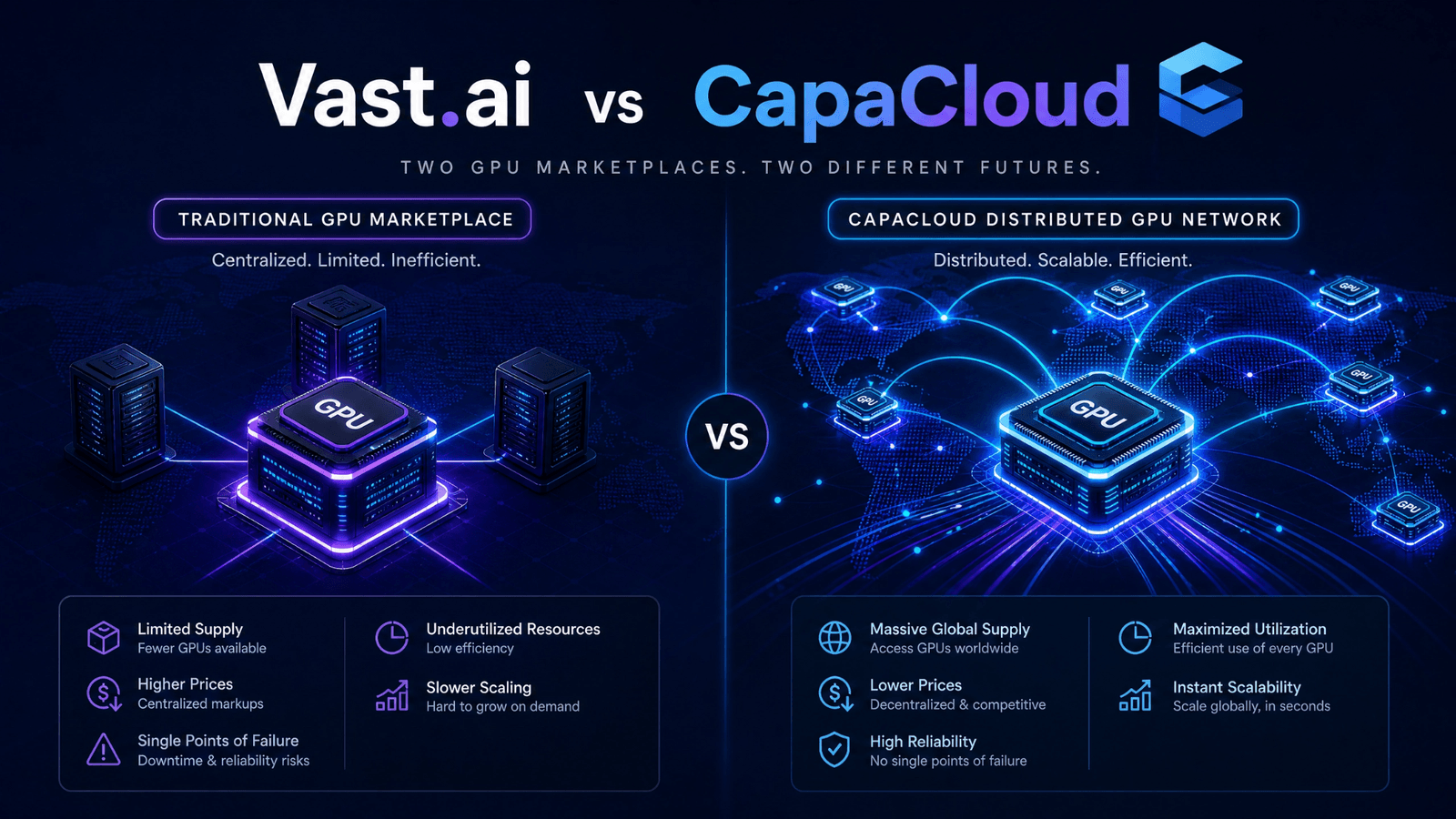
Both Vast.ai and CapaCloud give developers access to on-demand GPU compute through marketplace-based models, making them attractive alternatives to traditional cloud providers. However, they differ in how they position their infrastructure and the types of AI workloads they are designed to support. Understanding these differences can help you determine which platform best aligns with your development needs.
| Feature | Vast.ai | CapaCloud |
| Infrastructure Model | GPU marketplace | Distributed GPU marketplace |
| Compute Resources | Community-contributed GPUs | Distributed global GPU network |
| Pricing Model | Pay-as-you-go | Pay-as-you-go |
| Scalability | Depends on available marketplace resources | Built to support scalable AI workloads |
| Primary Use Cases | General-purpose GPU rental | AI training, inference, and high-performance computing |
Infrastructure Approach
Both platforms use a marketplace model that allows developers to rent GPU resources on demand. CapaCloud is positioned as a distributed GPU marketplace, connecting compute resources across a decentralized network to support AI training, inference, and high-performance computing workloads. This approach expands the pool of available GPU resources while giving developers the flexibility to scale as project requirements evolve.
Choosing the Right Platform
The right platform depends on your workload, budget, and infrastructure requirements. When comparing a Vast.ai alternative, consider questions such as:
- Can you consistently access the GPU models your projects require?
- Will the platform scale as your AI workloads grow?
- Does the pricing model align with your compute budget?
- How quickly can you provision GPU resources?
- Does the platform support your long-term AI infrastructure strategy?
Answering these questions helps ensure you’re selecting a GPU marketplace that meets both your current needs and future growth plans, rather than focusing solely on hourly pricing. Whether you’re training machine learning models, running inference workloads, or scaling production AI applications, evaluating the overall infrastructure experience is just as important as comparing costs.
FAQs
What is the best Vast.ai alternative?+
The best Vast.ai alternative depends on your specific requirements. Developers should compare factors such as GPU availability, scalability, deployment speed, pricing, and the ability to support AI workloads over time and that’s where Capa Cloud shines. The right platform is one that aligns with both your current projects and future infrastructure needs.
Why are developers choosing distributed GPU networks?+
Distributed GPU networks, like Capa Cloud, connect compute resources from multiple providers, giving developers access to a broader pool of GPUs through a single marketplace. This model improves infrastructure flexibility and helps organizations scale AI, machine learning, and high-performance computing workloads more efficiently.
What should I look for in a Vast.ai alternative?+
When evaluating a Vast.ai alternative, consider more than hourly pricing. Look at GPU availability, hardware selection, scalability, deployment speed, pricing transparency, and overall platform reliability. These factors have a greater impact on long-term productivity than cost alone.
Are distributed GPU marketplaces suitable for AI training?+
Yes. Distributed GPU marketplaces are well suited for AI training, model fine-tuning, inference, and other compute-intensive workloads. Marketplaces like Capa Cloud and Vast.ai provide access to GPUs on demand, allowing developers to scale resources as project requirements change without investing in dedicated hardware.
Is CapaCloud a decentralized GPU marketplace?+
Yes. CapaCloud is a distributed GPU marketplace that connects developers with on-demand GPU resources for AI training, inference, and high-performance computing. Its decentralized approach is designed to provide flexible, scalable GPU infrastructure for modern AI workloads.
Final Thought On Vast.ai Alternative
Choosing a Vast.ai alternative is about more than finding the lowest hourly GPU price.
As AI development continues to evolve, developers need infrastructure that provides reliable GPU access, scales with increasingly complex workloads, and offers the flexibility to adapt as projects grow. Distributed GPU networks address these needs by expanding access to compute resources through a marketplace model, making it easier to find the right infrastructure for everything from experimentation to production AI.
If you’re looking for a GPU marketplace that supports modern AI development, CapaCloud offers on-demand access to distributed GPU resources for training, inference, and high-performance computing.
Explore CapaCloud to see how its decentralized infrastructure can help you scale your AI workloads with greater flexibility and efficiency.