 CapaCloud blog
How to Reduce AI Infrastructure Costs with Decentralized GPU Networks
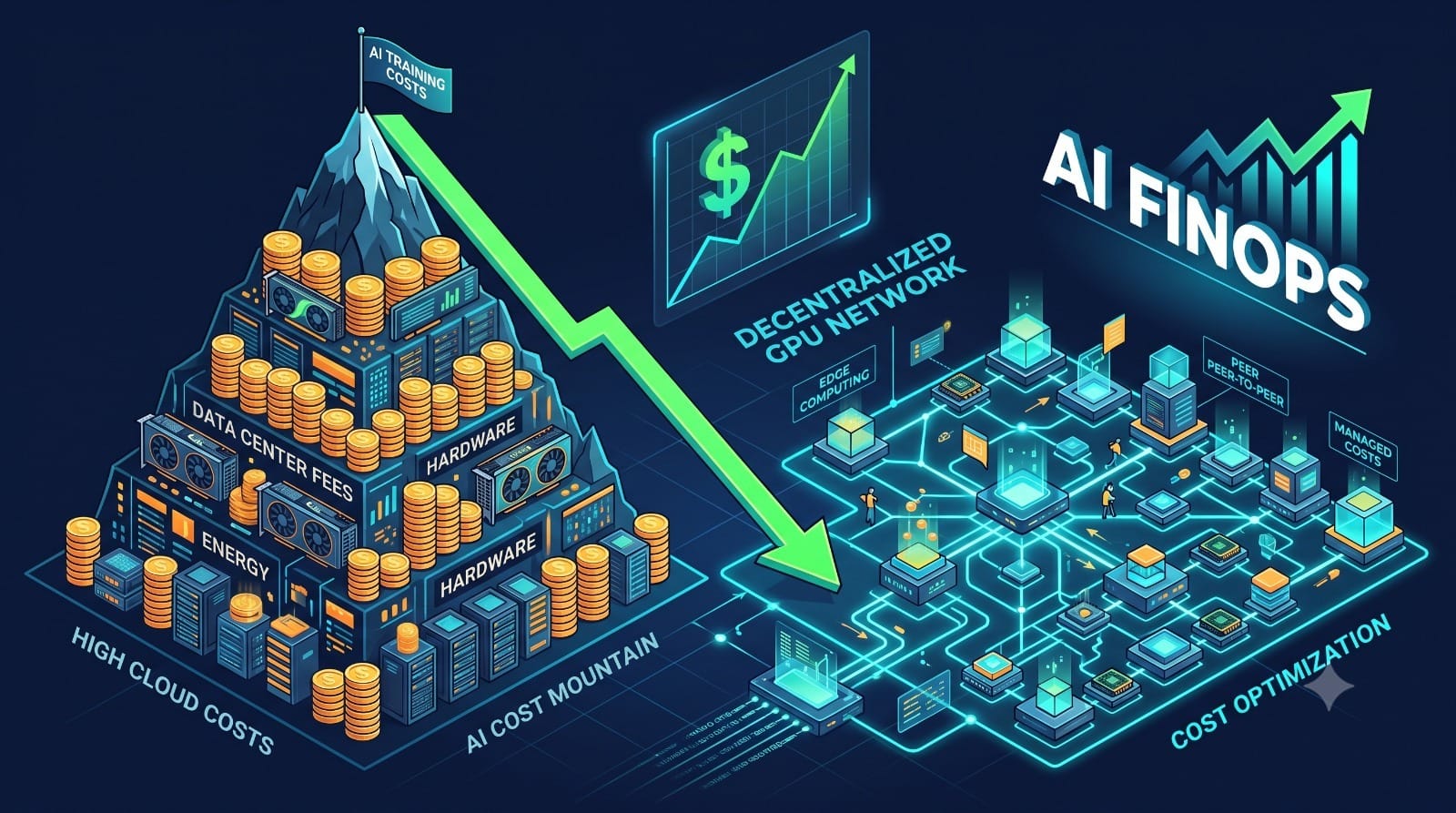
Learn how to reduce AI infrastructure costs with proven optimization strategies, AI FinOps practices, and decentralized GPU infrastructure. Discover practical ways to lower compute expenses, improve GPU utilization, and scale AI workloads more efficiently.
Key Takeaways
- AI infrastructure costs are increasing because of rising GPU demand, expanding inference workloads, and inefficient resource utilization.
- Improving GPU utilization, optimizing inference workloads, and implementing AI FinOps practices can substantially reduce infrastructure spending.
- Decentralized GPU networks provide flexible, pay-as-you-go access to compute resources and can help organizations lower compute acquisition costs.
- Metrics such as GPU utilization, cost per inference request, and training throughput per dollar are essential for measuring infrastructure efficiency.
- A hybrid infrastructure strategy that combines traditional cloud environments with decentralized compute can improve both cost efficiency and operational flexibility.
Artificial intelligence adoption is accelerating, but so are infrastructure costs. Beyond model training, organizations must manage expensive inference workloads, storage, networking, and operational overhead, often making AI systems costly to scale.
At the same time, rising demand for high-performance GPUs such as NVIDIA H100s has increased pricing and reduced availability across traditional cloud providers.
Organizations can control costs through better GPU utilization, AI FinOps practices, model optimization, and flexible infrastructure. Platforms such as Capacloud provide access to distributed GPU resources through pay-as-you-go pricing, helping teams scale AI workloads more cost-effectively.
Why AI Infrastructure Costs Are Rising in 2026
AI infrastructure spending has grown rapidly over the last few years. Organizations that previously ran small machine learning experiments are now supporting production-grade AI applications used by thousands or even millions of users.
Growing Demand for High-Performance GPUs
The widespread adoption of generative AI has dramatically increased demand for high-performance GPUs. Enterprises are training proprietary models, startups are launching AI-native products, and research institutions are running increasingly complex experiments.
This demand places enormous pressure on GPU availability. Premium accelerators often command premium prices, especially during periods of high demand. In some cases, organizations wait weeks or months to provision specialized hardware.
As a result, compute budgets continue to rise even before considering other operational expenses.
Inference Is Becoming More Expensive Than Training
Training remains expensive, but many organizations now discover that inference costs can exceed training costs over time.
Several factors contribute to this trend:
- AI applications increasingly require always-on inference endpoints.
- Agentic AI systems continuously process tasks and invoke multiple models.
- Long-context models consume significantly more memory and compute resources.
- Real-time applications demand low latency and high availability.
For example, an AI customer support platform serving thousands of users per day may generate continuous inference costs around the clock. Unlike training, which occurs periodically, inference often becomes a permanent operational expense.
Hidden Cost Drivers in AI Infrastructure
Many organizations focus only on GPU hourly rates while overlooking additional expenses.
Hidden cost drivers include:
- Idle GPU resources are left running after experiments finish.
- Overprovisioned infrastructure sized for peak demand.
- Checkpoint storage and model artifact retention.
- Cross-region data transfer fees.
- Distributed training communication overhead.
- Vector database storage and bandwidth.
- Engineering time spent managing infrastructure.
These hidden costs can quietly account for a significant portion of total infrastructure spending.
Proven Strategies to Reduce AI Infrastructure Costs
Reducing AI infrastructure costs does not always require major architectural changes or large capital investments. In many cases, organizations can achieve substantial savings by improving resource efficiency, optimizing workloads, and making smarter infrastructure decisions.
Many AI teams are also supplementing traditional cloud environments with decentralized GPU platforms such as Capacloud to access more flexible and cost-efficient compute resources. Distributed GPU marketplaces can offer competitive pricing for training, experimentation, and burst compute workloads while improving infrastructure flexibility.
The following strategies consistently help organizations lower compute expenses without compromising performance or scalability.
Improve GPU Utilization
Improving GPU utilization is often one of the fastest and most effective ways to reduce AI infrastructure costs. Many organizations provision expensive GPU resources that remain partially idle for long periods, resulting in unnecessary spending.
A GPU operating at low utilization costs nearly the same as one running at full capacity. Maximizing utilization helps organizations extract more value from existing infrastructure investments.
Organizations can improve GPU utilization by:
- Implementing autoscaling to provision resources only when needed
- Scheduling workloads intelligently to reduce idle time
- Consolidating compatible workloads onto shared infrastructure
- Sharing GPU resources across teams and projects
- Automatically terminating inactive instances
- Using workload queues to keep GPUs consistently occupied
Even moderate improvements in utilization rates can produce significant cost savings, particularly for organizations managing large-scale training and inference workloads.
Match Hardware to Workloads
Not every AI workload requires the most advanced or expensive GPU available. One of the most common infrastructure inefficiencies is using premium accelerators for lightweight inference tasks, experimentation, or smaller models that could run effectively on lower-cost hardware.
Selecting the appropriate hardware for each workload can significantly reduce compute expenses while maintaining performance.
Organizations should:
- Match GPU capabilities to workload requirements
- Separate training, fine-tuning, and inference environments
- Evaluate lower-cost GPUs for smaller models and development workloads
- Reserve high-performance accelerators for compute-intensive tasks
- Regularly reassess hardware allocation as workloads evolve
For example, large-scale model training may require premium accelerators, while smaller inference services or internal development environments can often run efficiently on more affordable infrastructure.
Optimize AI Models for Lower Compute Consumption
Model optimization techniques can dramatically reduce the computational resources required for both training and inference. Smaller and more efficient models frequently achieve comparable performance while consuming fewer GPU hours, less memory, and lower energy resources.
Common optimization approaches include:
- Quantization to reduce numerical precision and lower compute requirements
- Pruning to remove unnecessary model parameters while maintaining accuracy
- Knowledge distillation, where smaller models learn from larger models
- Parameter-efficient fine-tuning methods such as LoRA
- Model compression to improve deployment and serving efficiency
By optimizing models before deployment, organizations can reduce infrastructure costs, improve inference performance, and increase overall compute efficiency without negatively affecting user experience.
Key Metrics for Measuring AI Infrastructure Efficiency
Organizations cannot optimize what they do not measure. While reducing AI infrastructure costs is important, cost reduction efforts are only effective when teams have clear visibility into how infrastructure resources are being used.
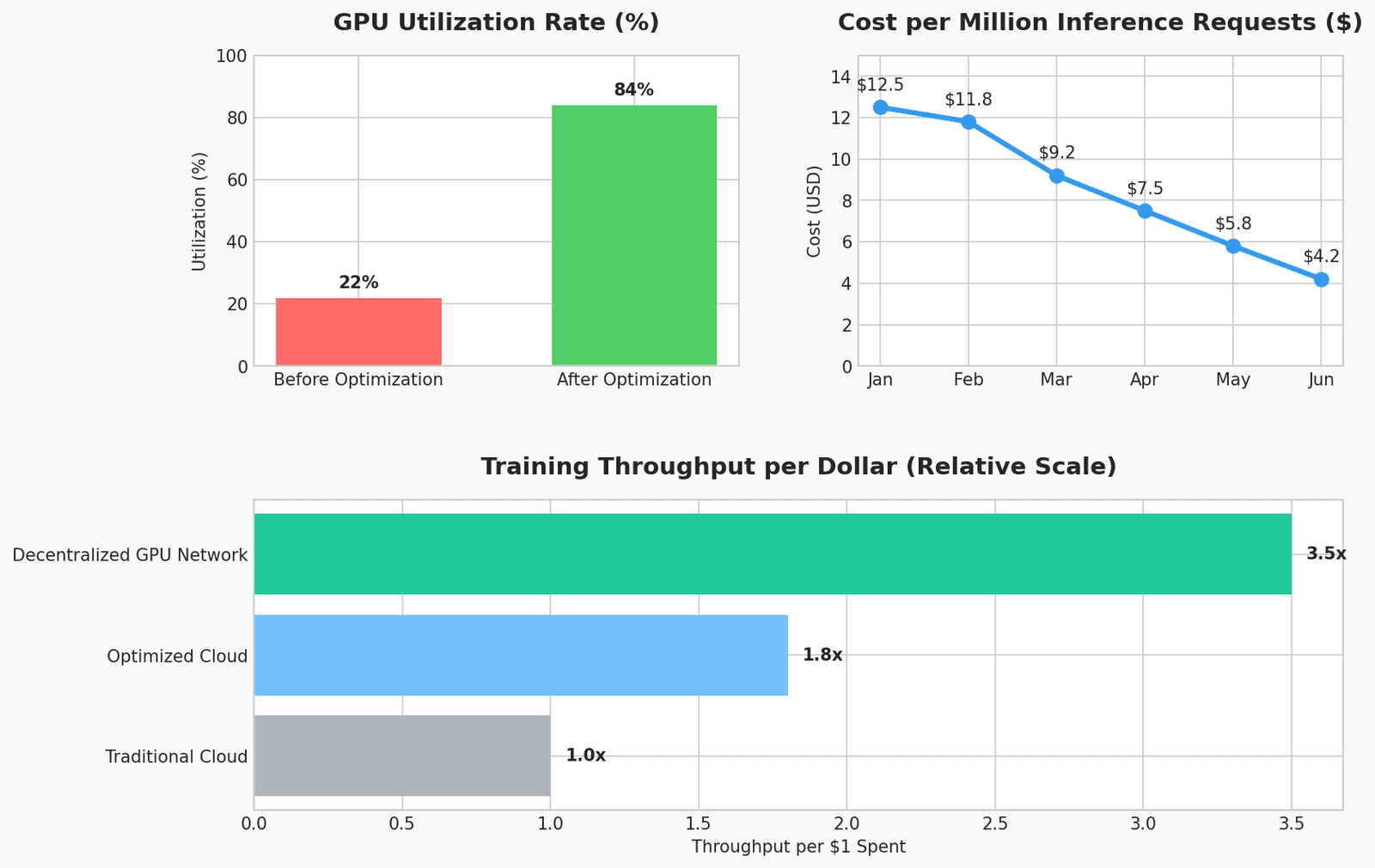
Tracking the right metrics helps organizations understand where money is being spent, identify inefficiencies, and make data-driven decisions about infrastructure investments. These measurements also make it easier to benchmark workloads, compare infrastructure providers, and evaluate the impact of optimization initiatives.
| Metric | Why It Matters |
| Cost per training run | Measures the total cost of individual training jobs and experiments. |
| Cost per inference request | Evaluates the efficiency and scalability of production inference workloads. |
| Cost per generated token | Helps assess the economics of large language model applications. |
| GPU utilization rate | Reveals whether GPU resources are being fully utilized or left idle. |
| Training throughput per dollar | Measures how much useful work is produced for every dollar spent on compute. |
| GPU memory efficiency | Identifies memory bottlenecks that may limit performance or increase costs. |
| Utilization-to-cost ratio | Provides a high-level view of overall infrastructure efficiency. |
Simple Formulas for Evaluating Compute Efficiency
Basic cost and utilization formulas can provide valuable insights into infrastructure performance and spending patterns.
Cost per Experiment
This metric helps teams understand how much each training run or research experiment actually costs.
Formula:
Total infrastructure spend ÷ Number of experiments
For example, if a team spends $20,000 per month on infrastructure and completes 100 experiments, the average cost per experiment is $200.
Cost per Million Inference Requests
Inference often becomes the largest recurring AI expense. Measuring cost at the request level helps organizations monitor serving efficiency as applications scale.
Formula:
Monthly inference spend ÷ Monthly inference requests × 1,000,000
Tracking this metric over time can reveal whether optimization efforts such as batching, caching, or model compression are delivering measurable savings.
GPU Utilization Rate
GPU utilization is one of the most important indicators of infrastructure efficiency. Low utilization often signals overprovisioning, idle resources, or inefficient workload scheduling.
Formula:
Active GPU time ÷ Total available GPU time × 100
For example, if GPUs are actively processing workloads for 18 hours of 24 hours, utilization is 75 percent.
By continuously monitoring these metrics, organizations can benchmark workloads, identify inefficiencies, and prioritize optimization opportunities that deliver the greatest financial impact.
Common Reasons Organizations Overspend on AI Infrastructure
Reducing AI infrastructure costs starts with understanding where money is being wasted. In many organizations, overspending is not caused by a lack of compute resources, but by inefficient processes, poor visibility, and underutilized infrastructure. Identifying these inefficiencies is often the fastest way to lower cloud and GPU expenses.
Idle and Underutilized GPUs
One of the most common sources of waste is low GPU utilization. Many teams provision expensive GPU instances for training or experimentation but use only a small portion of their available capacity.
For example, a GPU operating at just 20 percent utilization still incurs the full hourly cost. Whether the resource is actively processing workloads or sitting idle, organizations continue paying the same rate.
Idle resources often occur when:
- Developers forget to shut down instances after experiments.
- Workloads are scheduled inefficiently.
- Teams reserve compute resources for projects that are delayed or never launched.
- GPU capacity is provisioned for peak demand but remains unused during normal operations.
Even modest improvements in GPU utilization can produce significant cost savings, especially for organizations running large-scale AI workloads.
Duplicate Model Experiments
In fast-moving AI teams, it is not uncommon for multiple groups to train similar models independently without realizing that comparable work has already been completed elsewhere in the organization.
This duplication leads to unnecessary compute consumption, higher storage costs, and increased engineering overhead. Over time, repeated experiments can quietly consume thousands of dollars in GPU resources.
Implementing centralized experiment tracking, shared model repositories, and stronger collaboration practices can help teams reuse previous work, avoid redundant experiments, and improve overall infrastructure efficiency.
Forgotten Training Jobs
Long-running training jobs are another major source of infrastructure waste. Experiments sometimes continue running long after useful results have been generated, while failed jobs may remain active because errors go unnoticed.
Without proper monitoring and governance, these workloads can consume valuable GPU resources for days or even weeks.
Organizations can minimize this risk by implementing:
- Automated alerts for stalled or failed jobs.
- Idle timeout policies.
- Automatic resource shutdown rules.
- Continuous workload monitoring.
These safeguards help ensure that compute resources are used only when they deliver value.
Lack of Cost Ownership Across Teams
Many organizations struggle with AI infrastructure costs because no single team owns or manages spending. When infrastructure expenses are shared across multiple departments without clear visibility, accountability often decreases and costs rise.
Data scientists, ML engineers, platform teams, and business units may all consume compute resources without fully understanding their financial impact.
Establishing clear cost ownership, implementing chargeback or showback models, and adopting AI FinOps practices can provide greater transparency into infrastructure usage. When teams understand how their decisions affect overall spending, they are more likely to optimize workloads and use resources responsibly.
Strategies for Reducing AI Inference Costs
Inference optimization has become one of the most important areas of AI cost management.
Organizations can reduce inference spending by:
- Routing simple requests to smaller models.
- Caching frequently requested responses.
- Implementing dynamic batching.
- Reusing KV cache where appropriate.
- Deploying quantized models for serving.
Serverless inference architectures may also help reduce costs for workloads with unpredictable demand patterns by charging only for actual usage.
Establish AI FinOps Practices to Control Infrastructure Spending
As AI workloads scale, infrastructure governance becomes just as important as infrastructure performance. Without clear financial oversight, organizations can quickly lose visibility into how compute resources are being used, leading to budget overruns and inefficient spending.
AI FinOps extends traditional cloud financial management practices to AI and machine learning environments. It brings together engineering, finance, and business teams to ensure that AI infrastructure investments deliver measurable value while keeping costs under control.
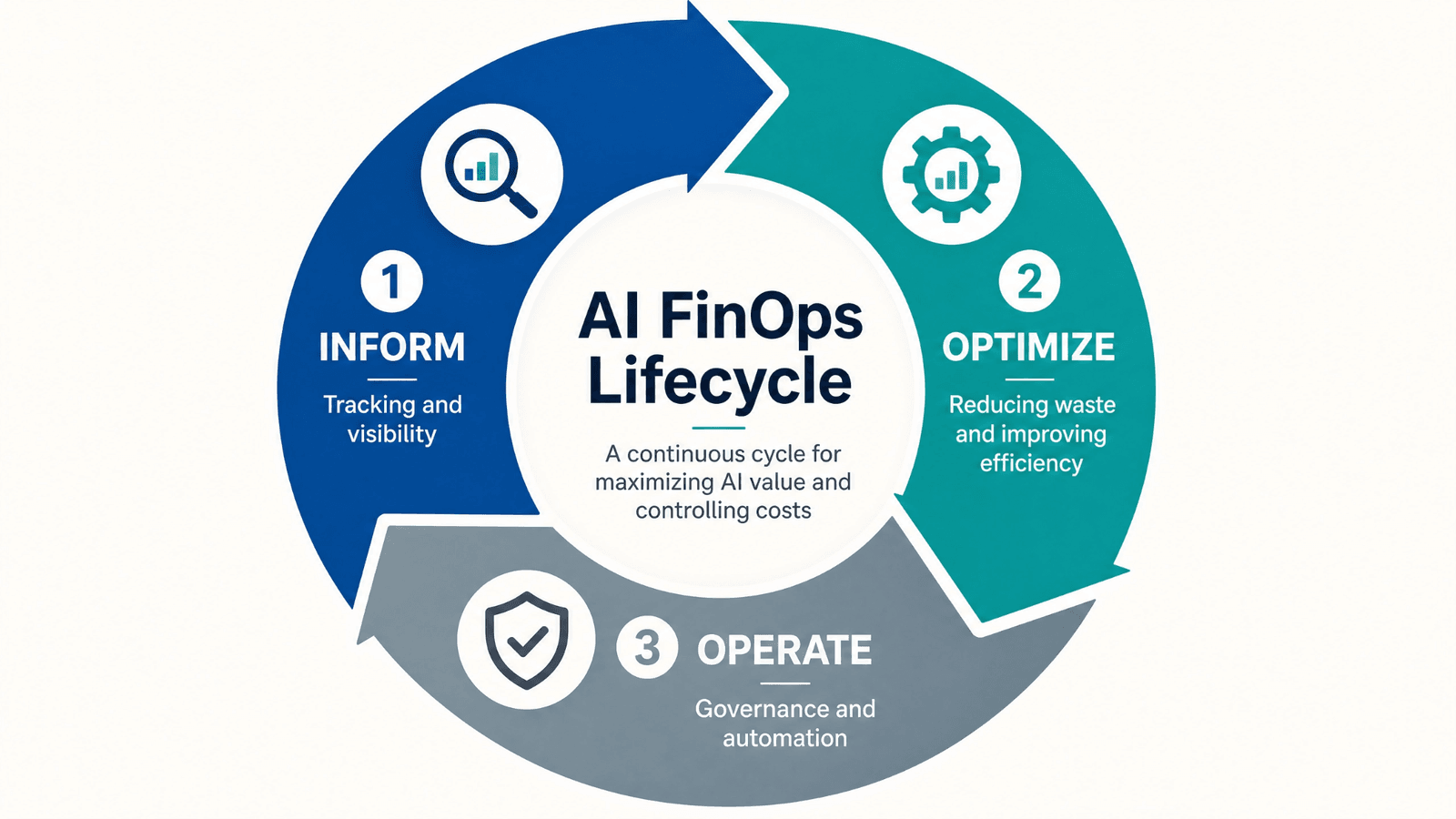
Implementing AI FinOps practices enables organizations to improve cost transparency, optimize resource allocation, and make more informed infrastructure decisions.
Track Compute Costs Across Teams
Many organizations struggle to understand which teams, projects, or workloads are responsible for infrastructure spending. Without this visibility, identifying inefficiencies becomes difficult.
Organizations should implement practices such as:
- Resource tagging for projects, departments, and environments.
- Project-level billing and cost allocation.
- Workload attribution for training and inference jobs.
- Chargeback or showback models to increase accountability.
Understanding who consumes compute resources, how they use them, and why they use them makes it easier to identify waste and optimize spending across the organization.
Implement Budget Guardrails
Unexpected cost spikes are common in AI environments, especially when experiments run longer than planned or infrastructure is unintentionally left active.
Budget guardrails help organizations maintain financial discipline without slowing innovation.
Examples include:
- Automated spending alerts when usage exceeds predefined thresholds.
- Usage quotas for teams or individual projects.
- Maximum budgets for training runs and experiments.
- Automatic shutdown policies for idle resources.
- Approval workflows for high-cost infrastructure requests.
These controls reduce the risk of unexpected cloud bills while ensuring teams can continue experimenting and innovating responsibly.
Use Cost Observability Tools
Modern cost observability platforms provide real-time visibility into infrastructure performance and spending patterns. Rather than waiting until the end of the month to review invoices, organizations can continuously monitor costs and take corrective action immediately.
Key metrics to monitor include:
- GPU utilization rates.
- Idle and underutilized resources.
- Cost anomalies and unexpected spending spikes.
- Forecasted infrastructure spend.
- Training and inference efficiency.
- Resource consumption by team, project, or workload.
Continuous monitoring enables organizations to proactively optimize infrastructure, identify cost-saving opportunities early, and prevent small inefficiencies from becoming significant financial burdens.
Organizations that adopt AI FinOps practices often discover that improving visibility and accountability alone can lead to substantial reductions in AI infrastructure spending.
FAQs
How can organizations reduce AI infrastructure costs?+
Organizations can reduce AI infrastructure costs by improving GPU utilization, optimizing AI models, implementing AI FinOps practices, automating resource management, and using cost-efficient compute platforms such as decentralized GPU networks. Regularly monitoring infrastructure usage also helps identify and eliminate unnecessary spending.
What workloads are best suited for decentralized GPU infrastructure?+
Decentralized GPU infrastructure is ideal for model training, fine-tuning, batch processing, experimentation, computer vision workloads, and scalable inference tasks. These workloads often benefit from flexible, pay-as-you-go access to distributed GPU resources.
How do decentralized GPU networks compare with traditional cloud providers?+
Decentralized GPU networks typically offer more flexible pricing and access to global GPU capacity, while traditional cloud providers often provide stronger compliance capabilities and tightly integrated cloud services. Many organizations use a hybrid approach to balance cost, performance, and reliability.
What is AI FinOps and why is it important?+
AI FinOps is the practice of managing and optimizing AI infrastructure spending through collaboration between engineering, finance, and business teams. It helps organizations improve cost visibility, establish budget controls, and maximize the return on AI investments.
How can organizations measure the efficiency of AI infrastructure?+
Organizations can measure AI infrastructure efficiency using metrics such as GPU utilization rate, cost per training run, cost per inference request, cost per generated token, and training throughput per dollar. Tracking these metrics helps teams identify inefficiencies and prioritize optimization efforts.
Final Thoughts on Reducing AI Infrastructure Costs
As AI adoption grows, infrastructure costs will continue to rise. However, organizations can control spending by improving GPU utilization, adopting AI FinOps practices, and optimizing workloads.
For many teams, a hybrid approach that combines traditional cloud platforms with decentralized GPU infrastructure offers the best balance of cost, scalability, and flexibility. Platforms such as Capacloud can help organizations access scalable GPU resources while reducing infrastructure costs.
Organizations that optimize their infrastructure today will be better positioned to scale AI initiatives efficiently in the future.