Discover how blockchain GPU marketplaces work, compare them to traditional cloud providers, explore real-world use cases, and learn why decentralized compute is the future of AI infrastructure.
Key Takeaways
- Blockchain GPU marketplaces unlock a global pool of idle GPUs, solving supply shortages and making high-performance compute accessible to anyone
- They reduce compute costs by up to 80%, with platforms like CapaCloud leading through true pay-per-use pricing and zero idle cost models
- Users gain flexible, on-demand scalability for AI training, rendering, and data workloads, without long-term commitments or vendor lock-in
- Blockchain enables trust, transparency, and automation, and enhance this with privacy-first, secure compute environments
- CapaCloud represents the future of compute (neocloud), combining decentralized infrastructure, global GPU access, and full user control into one platform
The global demand for GPU compute has reached a breaking point.
AI models are growing exponentially in size. Training a modern large language model can require thousands of GPUs running for weeks, while even mid-sized machine learning workloads demand infrastructure that was once reserved for enterprise labs.
At the same time:
- GPU shortages are becoming common
- Cloud costs are rising dramatically
- Access to high-performance compute remains uneven
Traditional cloud providers, while powerful are no longer sufficient on their own.
This is where the blockchain GPU marketplace emerges as a transformative solution.
Rather than relying on centralized infrastructure, these platforms create a global, decentralized compute economy, unlocking unused GPU capacity and making it accessible to anyone, anywhere.
This isn’t just an alternative to the cloud.
It’s a fundamental shift in how compute is owned, distributed, and monetized.
What Is a Blockchain GPU Marketplace?
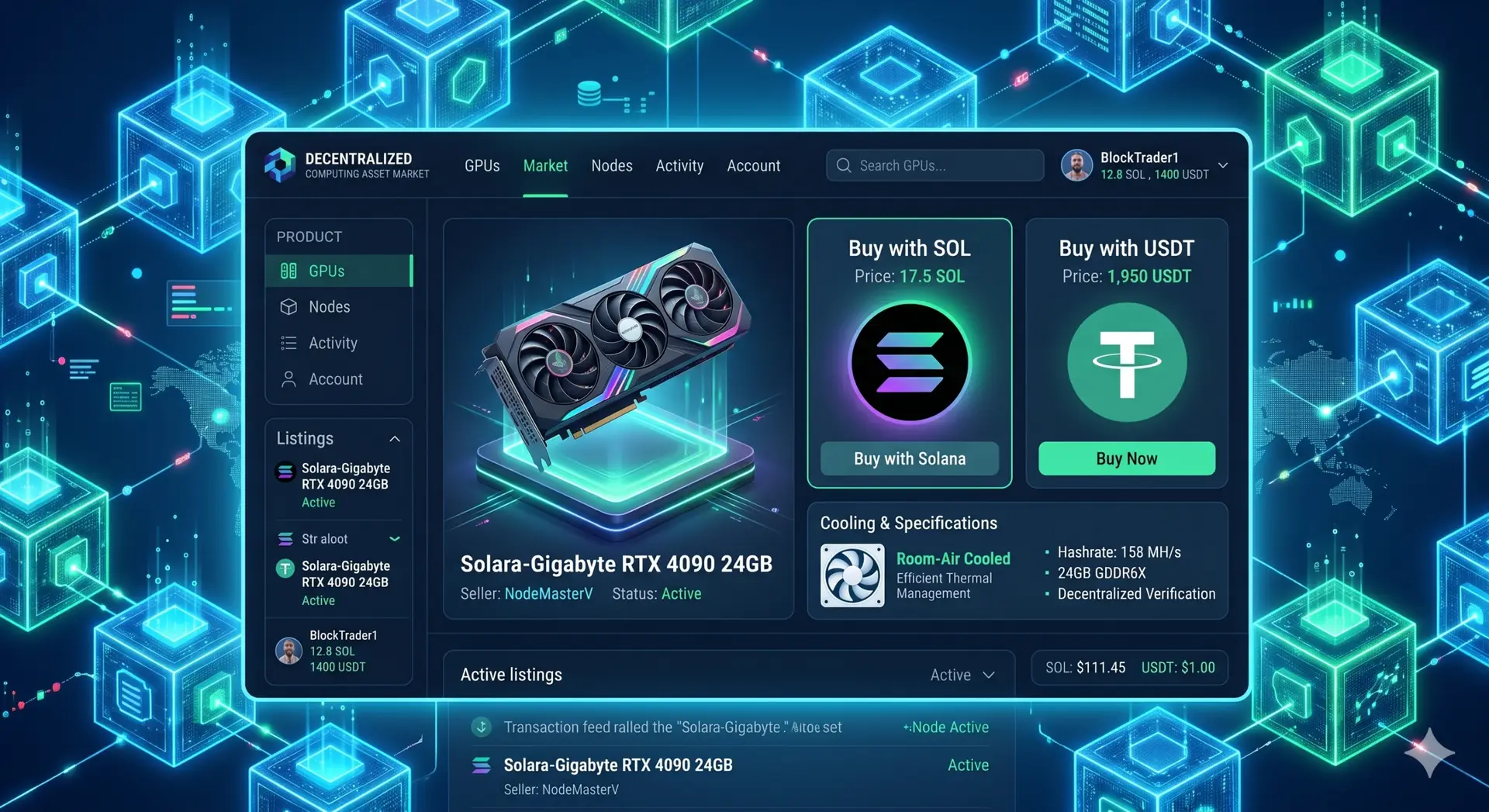
A blockchain GPU marketplace is a decentralized platform where GPU owners and compute users connect directly through a peer-to-peer network.
Instead of renting compute from a single provider, users access a distributed pool of GPUs, often coordinated through blockchain infrastructure.
Core Idea
- GPU owners list their hardware
- Users rent compute on demand
- Smart contracts automate execution and payment
Why a Blockchain GPU Marketplace Matters
Traditional cloud computing has powered a lot of today’s technology, but it comes with some clear limitations. As demand for GPUs grows, especially for AI and rendering, those limitations are becoming harder to ignore.
A blockchain GPU marketplace offers a different approach. Instead of relying on a few large providers, it opens access to a global pool of compute. This makes GPU access more flexible, more affordable, and more widely available.
Here are the three main problems it solves:
1. Idle Hardware Waste
There are millions of GPUs around the world that sit unused most of the time. This includes personal gaming setups and even enterprise machines that are only needed during peak periods.
In the traditional model, that unused power just goes to waste.
A blockchain GPU marketplace changes that by letting people and companies share their idle GPUs. Those resources can now be rented out, which increases overall supply without needing new hardware. It also creates a new way for owners to earn from machines that would otherwise sit idle.
2. Artificial Scarcity
With traditional cloud providers, you can only use what they have available in their own data centers. Even if GPUs exist elsewhere, you cannot access them.
This often leads to shortages, wait times, or limited availability in certain regions.
A decentralized marketplace removes that limitation. It pulls together GPU supply from across the world, so users are not stuck with a single provider’s inventory. This makes it easier to find available compute when you need it.
3. Centralized Pricing Power
Cloud pricing is usually set by a few large companies. Users have little control, and costs can stay high because there is not much competition.
A blockchain GPU marketplace introduces a more open pricing model. Providers can set their own rates, and users can choose the best option for their needs. This creates competition and helps bring prices closer to what the market is actually willing to pay.
The Core Problem Blockchain GPU Marketplace Solves
The rise of AI, machine learning, and high-performance computing has created a massive imbalance:
Demand Side
- AI model training requires massive GPU clusters
- Rendering and simulation workloads are increasing
- Scientific research depends on high-performance compute
Supply Side (Inefficiency)
- Millions of GPUs sit idle globally
- Gaming rigs are unused most of the day
- Enterprise hardware is underutilized
The Result:
- GPU shortages in centralized clouds
- High compute costs
- Limited access for smaller teams
The Solution: Blockchain GPU Marketplaces
These platforms unlock idle GPU capacity and make it available globally, creating:
- A more efficient compute economy
- Lower prices through competition
- Greater accessibility for developers and researchers
Key Components: Blockchain, GPUs, and Smart Contracts
A blockchain GPU marketplace relies on three core technologies:
1. GPUs (Compute Layer)
The actual hardware performing tasks such as:
- AI training
- Rendering
- Data processing
2. Blockchain (Coordination Layer)
Used to:
- Record transactions
- Ensure transparency
- Enable trustless interactions
3. Smart Contracts (Automation Layer)
Automatically handle:
- Job agreements
- Payments
- Verification
Together, these components create a self-operating, trustless compute marketplace.
How a Blockchain GPU Marketplace Works: Step-by-Step
For Providers: Monetizing Idle GPU Power
If you own a GPU, you can turn it into a revenue-generating asset.
Step-by-step:
- Install marketplace software
- Connect your GPU to the network
- Set pricing or accept market rates
- Receive jobs automatically
Benefits for Providers:
- Earn passive income
- Maximize hardware utilization
- Participate in a global compute economy
For Consumers: Accessing On-Demand GPU Compute
Users looking for compute power can:
Step-by-step:
- Browse available GPU listings
- Select hardware based on specs and price
- Deploy workloads (AI training, rendering, etc.)
- Pay per usage
Key Advantages:
- No long-term commitments
- Instant access to compute
- Flexible scaling
Benefits of a Blockchain GPU Marketplace
1. Cost Reduction at Scale
Decentralized GPU marketplaces are significantly cheaper than traditional cloud providers.
Typical pricing comparison:
| GPU Type | AWS | Decentralized |
| Mid-tier GPU | $2–$4/hr | $0.50–$1.50/hr |
| A100 GPU | $8–$12/hr | $2–$6/hr |
Why costs are lower:
- No centralized infrastructure overhead
- Market-driven pricing
- Utilization of idle resources
For AI teams, this can reduce compute costs by 50–80%.
2. Global Access to Compute
Unlike AWS, which operates in fixed regions, decentralized networks are:
- Globally distributed
- Not region-locked
- Continuously expanding
Result:
- Better availability
- Reduced GPU shortages
- Faster access to high-demand hardware
3. Sustainability by Design
Traditional cloud = build more infrastructure
Decentralized compute = use existing infrastructure
Environmental advantages:
- No new hardware manufacturing
- Reduced idle energy waste
- Lower cooling requirements
This makes decentralized compute a strong carbon-efficient alternative to AWS.
4. No Vendor Lock-In
You’re not tied to:
- Proprietary APIs
- Cloud ecosystems
- Long-term contracts
Benefits:
- Full infrastructure control
- Easier migration
- Hybrid deployment flexibility
5. Transparency and Trust
Blockchain ensures:
- Transparent pricing
- Immutable transaction records
- Reduced fraud
Users gain visibility that traditional cloud providers don’t offer.
Blockchain GPU Marketplace Use Cases and Applications
1. Artificial Intelligence and Machine Learning
Blockchain GPU marketplaces are transforming AI development.
Common use cases:
- Training deep learning models
- Fine-tuning large language models
- Running inference pipelines
Why it matters:
- AI workloads are extremely compute-intensive
- Lower costs unlock more experimentation
2. 3D Rendering and Content Creation
Creative professionals benefit from:
- Faster rendering times
- Lower infrastructure costs
- On-demand scalability
Applications:
- Animation
- Visual effects (VFX)
- Game development
4. Scientific Research and Data Analysis
Researchers use decentralized GPU compute for:
- Climate modeling
- Genomics analysis
- Physics simulations
Key advantage:
- Access to compute without institutional constraints
This democratizes access to high-performance computing globally.
Challenges of the Blockchain GPU Marketplace
While blockchain GPU marketplaces offer a compelling alternative to traditional cloud infrastructure, the space is still developing. Like any emerging technology, it comes with a set of challenges that need to be addressed before it can reach mainstream adoption.
Here are the key issues shaping the current landscape:
1. Adoption
Blockchain GPU marketplaces are still early in their lifecycle. Compared to traditional cloud platforms, awareness is relatively low, and many developers or businesses are unfamiliar with how these systems work.
There is also a learning curve involved. Users need to understand concepts like decentralized networks, wallet-based payments, and marketplace dynamics. For teams used to plug-and-play cloud services, this shift can feel complex at first.
As a result:
- Adoption is growing, but not yet widespread
- Education and onboarding remain critical
- Trust needs to be built over time through consistent performance
As more success stories emerge and platforms improve user experience, this barrier is expected to gradually decrease.
2. Quality Control
In a decentralized marketplace, not all GPUs are equal. Performance can vary depending on hardware type, location, network stability, and how well the provider maintains their system.
Unlike centralized providers that standardize their infrastructure, decentralized networks rely on a mix of contributors. This creates variability that users need to navigate.
Current challenges include:
- Inconsistent performance across providers
- Limited standardization of hardware tiers
- Difficulty predicting reliability for critical workloads
Many platforms are working on reputation systems, benchmarking tools, and verification layers to improve trust and consistency. Over time, these mechanisms will help create a more predictable experience.
3. Interoperability
Integrating blockchain GPU marketplaces into existing workflows is not always straightforward. Most teams already rely on established tools, cloud environments, and deployment pipelines.
Switching or even partially integrating a decentralized solution can require additional setup and adjustments.
Common friction points include:
- Compatibility with existing DevOps and MLOps pipelines
- Differences in APIs and deployment processes
- Extra steps for managing payments or identities
Until integration becomes more seamless, this can slow down adoption, especially for larger teams with complex systems.
Why CapaCloud Is the Best Blockchain GPU Marketplace
Not all decentralized GPU platforms are created equal. Some promise a lot but fall short when it comes to performance, ease of use, or real-world value.
That’s where CapaCloud truly stands out. It doesn’t just lean on the idea of decentralization, it brings together powerful performance, a user-friendly experience, and practical solutions that actually work in real-world scenarios.
Instead of forcing users to compromise, CapaCloud strikes the right balance, making it a reliable and forward-thinking choice in the blockchain GPU space.
CapaCloud Advantages
- True pay-per-use pricing with no subscriptions or idle costs, so you only pay for the exact compute you use
- Full root access and control including SSH access, custom environments, and no platform restrictions
- Privacy-first design with no personal data required, no centralized accounts, and support for ephemeral workloads
- Sustainable by design by using existing GPUs, reducing waste, and cutting carbon footprint per task by up to 99%
CapaCloud Key Differentiators
- Zero vendor lock-in
- Built for high-performance workloads
- Global GPU supply access
- Future-ready neocloud architecture
Unlike many platforms, CapaCloud is built for real usage, not experimentation.
FAQs
What is a blockchain GPU marketplace?
A blockchain GPU marketplace is a decentralized platform where GPU owners rent out their hardware to users who need compute power. It connects providers and consumers through a peer-to-peer network, using blockchain and smart contracts to automate transactions, payments, and job execution.
How does a blockchain GPU marketplace differ from traditional cloud providers?
Unlike traditional cloud providers that rely on centralized infrastructure and fixed pricing, blockchain GPU marketplaces like CapaCloud use globally distributed GPUs, offer market-driven pricing, enable on-demand access, and eliminate long-term contracts and vendor lock-in.
Who benefits from using blockchain GPU marketplaces?
AI engineers, data scientists, developers, researchers, and creative professionals can all benefit. Users gain instant access to GPUs for training models, running inference, rendering 3D graphics, or conducting scientific simulations without long-term contracts or vendor lock-in.
What is CapaCloud and why is it different from other platforms?
CapaCloud is a blockchain GPU marketplace that combines global GPU access, decentralized infrastructure, and user control. It stands out with true pay-per-use pricing, full root/SSH access, privacy-first architecture, zero vendor lock-in, and sustainability-focused design for real-world high-performance workloads.
How do GPU owners monetize their hardware on CapaCloud?
GPU owners install the platform software, connect their GPUs, set pricing or accept market rates, and receive compute jobs automatically. This allows them to earn passive income while maximizing underutilized hardware.
Final Thought on Blockchain GPU Marketplace
If you’re still relying solely on traditional cloud providers, you might be missing out on major advantages like lower costs, greater flexibility, and seamless scalability.
With blockchain GPU marketplace like CapaCloud, you can significantly reduce your compute expenses while instantly accessing a global pool of GPU power. It allows you to build and deploy without being held back by infrastructure limitations.
As adoption grows and the ecosystem matures, this model is becoming less of an alternative and more of a new standard. Compute is shifting toward an open, market-driven system where access is easier, pricing is fairer, and innovation is no longer limited by infrastructure.