 CapaCloud blog
CoreWeave Alternative: Best Decentralized GPU Infrastructure for AI Startups

Explore CoreWeave alternatives for AI startups and discover how decentralized GPU infrastructure provides flexible, scalable compute for AI workloads.
TL;DR
- CoreWeave provides specialized GPU cloud infrastructure for AI workloads.
- AI startups may seek alternatives for flexibility, availability, and cost considerations.
- Decentralized GPU infrastructure offers a distributed approach to GPU computing.
- CapaCloud provides access to distributed GPU resources through a decentralized marketplace.
- Choosing an alternative depends on workload, GPU, scalability, and infrastructure requirements.
AI startups need access to powerful GPUs to train models, fine-tune applications, run inference, and support other compute-intensive workloads.
As these requirements grow, choosing the right infrastructure can have a direct impact on how efficiently teams develop and scale their products.
CoreWeave has emerged as a specialized cloud provider focused on GPU-intensive workloads. However, a single infrastructure model may not suit every startup, particularly teams looking for flexible access to distributed compute resources or different ways to manage GPU capacity.
CapaCloud offers a decentralized alternative that connects users with distributed GPU resources through a peer-to-peer marketplace.
Rather than depending entirely on GPUs operated by a single centralized provider, CapaCloud’s model brings together GPU capacity from multiple sources and makes that capacity available for on-demand use.
Table of Contents
- TL;DR
- What Is CoreWeave?
- What Is Decentralized GPU Infrastructure?
- CapaCloud as a CoreWeave Alternative
- Benefits of Decentralized GPU Infrastructure for AI Startups
- Centralized vs. Decentralized GPU Infrastructure
- CoreWeave Alternative for AI Training
- CoreWeave Alternative for AI Inference
- What to Evaluate Before Choosing Infrastructure
- CoreWeave vs. CapaCloud: What Is the Difference?
- How to Choose a CoreWeave Alternative for Your AI Startup
- CoreWeave Alternative: What Should AI Startups Consider?
- FAQs
- Final Thoughts on CoreWeave Alternative
What Is CoreWeave?
CoreWeave is a cloud infrastructure provider focused on GPU computing for artificial intelligence, machine learning, and other demanding workloads.
Instead of purchasing and maintaining GPU hardware directly, organizations can provision GPU resources through a specialized cloud infrastructure platform.
What Can CoreWeave GPU Infrastructure Be Used For?
GPU infrastructure can support workloads such as:
- AI model training
- Model fine-tuning
- Machine learning development
- AI inference
- High-performance computing
- Development and experimentation
For startups, using cloud GPU infrastructure can reduce the need to purchase and operate dedicated hardware. However, the most appropriate infrastructure model depends on the workload, required GPUs, capacity requirements, and operating environment.
Why Look for a CoreWeave Alternative?
- GPU availability: AI workloads often require specific GPU configurations, making availability important when startups need to scale compute or run multiple workloads simultaneously.
- Infrastructure flexibility: Compute requirements can change as startups move from experimentation to production. Alternative infrastructure models can provide more flexibility as those requirements evolve.
- Cost and resource utilization: Total GPU infrastructure costs can include compute, storage, data transfer, workload duration, and unused capacity. Comparing these factors helps startups identify an infrastructure model that fits their usage patterns.
- Reducing dependence on one infrastructure model: Some AI teams may prefer to consider multiple infrastructure options rather than relying entirely on one provider or architecture. Decentralized GPU infrastructure offers another model alongside traditional cloud infrastructure.
What Is Decentralized GPU Infrastructure?
Decentralized GPU infrastructure distributes computing resources across multiple providers or locations and makes that capacity available through a shared network or marketplace.
Instead of all GPUs being owned and operated by one centralized infrastructure provider, the network can connect GPU owners that have available capacity with users that need compute.
How Distributed GPU Resources Work
The basic model involves two sides:
GPU providers contribute available hardware to the network.
GPU users rent that capacity for their workloads.
A marketplace coordinates access between the two, allowing available GPU resources to be used when demand exists.
This model can make distributed computing capacity available without requiring every user to purchase and maintain the underlying hardware.
CapaCloud as a CoreWeave Alternative
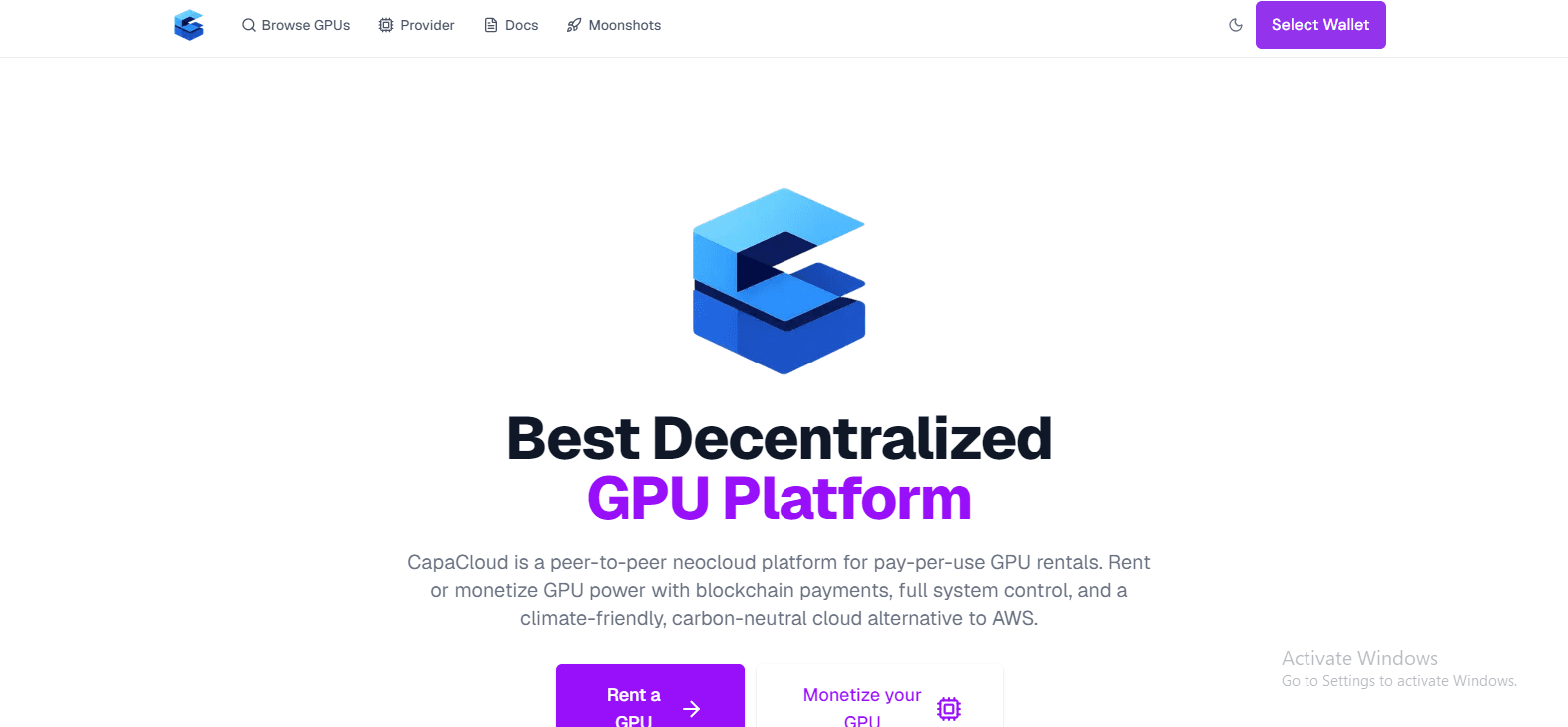
CapaCloud offers a different approach to GPU infrastructure by operating as a decentralized GPU marketplace. Rather than depending on a single centralized provider to supply computing capacity, CapaCloud connects users with distributed GPU resources that can be rented on demand.
This model is particularly relevant for AI startups, developers, researchers, and teams whose compute requirements can change from one project to another. Instead of purchasing and maintaining physical GPUs, users can access the computing resources needed for workloads such as AI training, fine-tuning, inference, and other GPU-intensive tasks.
CapaCloud’s Decentralized GPU Model
CapaCloud brings together GPU providers and users through a shared marketplace. Providers can make available GPU capacity, while users can access that capacity based on their workload requirements.
The model provides:
- Distributed GPU resources from multiple providers
- On-demand GPU rental for flexible compute access
- Peer-to-peer infrastructure connecting providers and users
- Marketplace-based access to available computing capacity
- Pay-as-you-go usage for teams that do not need permanent GPU infrastructure
This gives AI teams another way to access compute without committing to owning and operating their own GPU hardware.
Peer-to-Peer GPU Marketplace
The CapaCloud marketplace creates a direct connection between GPU providers with available capacity and users looking for compute resources. Providers can contribute their GPUs to the network, while users can select available resources for their workloads.
For startups, this marketplace model can be useful when GPU requirements fluctuate. A team may need additional capacity for model training or fine-tuning, then reduce its usage once the workload is complete.
How the CapaCloud Marketplace Works
The process is straightforward:
- Providers contribute GPU capacity: Available GPUs are added to the decentralized network.
- Users find suitable resources: Users can explore available computing capacity based on their workload needs.
- Users rent GPU compute: The required resources are rented for the intended workload.
- Workloads run on rented infrastructure: Teams can use GPU capacity without purchasing the underlying hardware.
- Providers monetize unused capacity: Available GPU resources can be put to productive use when they are not being used for other purposes.
CapaCloud’s Approach to Decentralized Computing
CapaCloud is built around a broader vision of making GPU computing more accessible through distributed infrastructure. By bringing available GPU resources into a shared marketplace, the platform provides an alternative to the traditional model where compute capacity is concentrated within a single cloud provider.
For AI startups, this creates another path to scalable GPU infrastructure. Whether the requirement is short-term experimentation, model development, fine-tuning, AI inference, or larger compute workloads, CapaCloud gives teams a way to explore distributed GPU capacity based on their specific needs.
Benefits of Decentralized GPU Infrastructure for AI Startups
Flexible GPU Access
Startups can access GPU resources based on their current workloads instead of committing to permanent hardware capacity. This can be useful when compute requirements change between development, training, and production.
Pay-Per-Use Computing
Usage-based GPU access allows teams to pay for the compute resources they use. This can help startups avoid investing heavily in hardware that may sit idle between workloads.
Distributed Compute Capacity
A decentralized network can bring together GPU resources from multiple providers. This creates a broader pool of computing capacity rather than depending on hardware from a single infrastructure operator.
Scalability
As workloads grow, startups can look for additional GPU capacity through the network. This can support changing requirements across model training, experimentation, inference, and other compute-intensive workloads.
An Alternative Infrastructure Model
Decentralized GPU infrastructure gives AI startups another option alongside traditional cloud providers. It can be considered as part of a broader infrastructure strategy when teams want more flexibility in how they access GPU compute.
Centralized vs. Decentralized GPU Infrastructure
The fundamental difference is how computing resources are organized.
A centralized cloud provider operates its GPU infrastructure as a managed service. A decentralized GPU marketplace connects computing resources from multiple providers through a distributed network.
| Factor | Centralized GPU Cloud | Decentralized GPU Infrastructure |
| Infrastructure model | Infrastructure operated by a centralized provider | Resources contributed by multiple providers |
| GPU resources | Managed within the provider’s infrastructure | Distributed across participating resources |
| Compute access | Provisioned through the cloud platform | Accessed through a marketplace or network |
| Capacity | Dependent on provider infrastructure and availability | Dependent on available distributed resources |
| Scaling | Scaling within the provider’s available capacity | Scaling through available network resources |
| Payment | Cloud infrastructure billing | Marketplace-based usage models can support pay-per-use access |
| Operational considerations | Centralized infrastructure management | Requires consideration of distributed resource characteristics |
Neither architecture should be evaluated in isolation. The relevant question is how each model behaves under the startup’s actual workload.
CoreWeave Alternative for AI Training
AI training can require substantial GPU capacity, particularly when teams are working with larger models, datasets, or repeated experiments. Startups therefore need infrastructure that can provide suitable GPUs without making hardware ownership a requirement.
GPU Requirements
The right configuration depends on the model and training workload. Teams should consider:
- GPU model and performance
- VRAM requirements
- Number of GPUs needed
- Training duration
- Storage requirements
- Inter-GPU communication for distributed training
Training and Fine-Tuning
GPU infrastructure can support several stages of AI development, including:
- Model training
- Fine-tuning
- Experimentation
- Hyperparameter testing
- Batch processing
Decentralized GPU infrastructure can provide an additional source of compute for workloads that can operate effectively across distributed resources.
When Decentralized Infrastructure Can Support Training
Decentralized GPU infrastructure can be considered when a workload can work with the available GPU configurations and network characteristics. It may be particularly relevant for startups that need additional compute for experimentation, fine-tuning, or workloads where infrastructure flexibility is important.
For highly distributed training workloads, teams should assess networking performance and inter-GPU communication before deployment.
CoreWeave Alternative for AI Inference
AI inference has different infrastructure requirements from model training. Applications serving users in real time may place greater emphasis on response times, GPU availability, and where the compute resources are located.
Inference Requirements
Important considerations include:
- GPU memory and performance
- Expected request volume
- Concurrent users or requests
- Model size
- Required throughput
- Response-time requirements
Latency and Availability
For inference applications, the location and availability of GPU resources can affect the overall user experience. Teams should consider network latency, resource availability, and the consistency of compute access when evaluating a decentralized infrastructure option.
For Further Insights read: AI Inference Hosting: Scaling Production LLMs with Decentralized Infrastructure
What to Evaluate Before Choosing Infrastructure
Before selecting a GPU infrastructure provider or marketplace, AI startups should assess:
- GPU availability: Can the required GPUs be accessed when needed?
- Performance: Does the available hardware meet workload requirements?
- Latency: Is network performance suitable for the application?
- Reliability: Can the infrastructure support the expected workload consistently?
- Scalability: Can compute capacity increase as demand grows?
- Cost: What is the total cost of running the workload, including compute, storage, and data transfer?
- Workload compatibility: Does the infrastructure support the technical requirements of the application?
CoreWeave vs. CapaCloud: What Is the Difference?
CoreWeave and CapaCloud provide access to GPU computing through different infrastructure models.
CoreWeave operates as a centralized cloud infrastructure provider, while CapaCloud uses a decentralized peer-to-peer marketplace model to connect users with distributed GPU resources.
| Factor | CoreWeave | CapaCloud |
| Infrastructure model | Centralized cloud infrastructure | Decentralized GPU marketplace |
| GPU resource model | Resources managed by the cloud provider | Resources contributed by multiple sources |
| Compute access | Provisioned through a cloud platform | Accessed through a peer-to-peer marketplace |
| Resource distribution | Centralized infrastructure | Distributed resources |
| Usage model | Cloud-based infrastructure billing | Marketplace-based GPU rental |
| Workload evaluation | GPU, performance, networking, availability, cost | GPU, performance, networking, availability, cost |
The architectural distinction is important, but it does not by itself determine which option is appropriate.
A startup should evaluate each option against its own workload requirements.
How to Choose a CoreWeave Alternative for Your AI Startup
Choosing GPU infrastructure should start with the workload, not the provider. AI startups can use the following steps to identify an infrastructure model that fits their technical and operational needs.
Define Your GPU Requirements
Determine the hardware your workloads actually require. Consider:
- GPU model and performance
- VRAM capacity
- Number of GPUs
- Expected compute hours
- Storage requirements
Identify Your Workload Type
Different workloads place different demands on infrastructure. Identify whether you primarily need GPUs for:
- Model training
- Fine-tuning
- AI inference
- Development and experimentation
- High-performance computing
Calculate Total Infrastructure Costs
Do not compare GPU rates alone. Account for the full cost of running your workloads, including:
- GPU compute
- Storage
- Data transfer
- Networking
- Idle capacity
- Additional infrastructure
This gives you a more realistic picture of what an infrastructure option will cost over time.
Evaluate GPU Availability
Check whether the provider or marketplace consistently offers the GPU configurations your workloads require. Availability becomes especially important when you need to scale quickly or run multiple workloads simultaneously.
Consider Infrastructure Flexibility
Think about how your compute needs may change as the startup grows. An infrastructure model that allows you to adjust GPU usage as workloads change can be useful when moving from experimentation to production.
CoreWeave Alternative: What Should AI Startups Consider?
When comparing CoreWeave with other GPU infrastructure options, focus on the factors that directly affect your workloads and operations:
- GPU availability: Access to the hardware your workloads require.
- Performance: GPU capabilities, throughput, and workload performance.
- Scalability: Ability to increase or decrease compute capacity.
- Cost: Total workload costs across compute, storage, and data transfer.
- Networking: Bandwidth and latency, particularly for distributed workloads.
- Reliability: Consistency and availability of the infrastructure.
- Geographic availability: Where GPU resources are located and how that affects your workloads.
No single factor should be considered in isolation. The right choice depends on how these characteristics align with your startup’s specific requirements.
FAQs
What is the best CoreWeave alternative for AI startups?
There is no single option that fits every AI startup. The right alternative depends on factors such as GPU requirements, workload type, availability, scalability, networking, and total infrastructure costs.
Is CapaCloud a CoreWeave alternative?
Yes. CapaCloud provides a different approach to GPU infrastructure through a decentralized, peer-to-peer marketplace that connects users with distributed GPU resources. Its model differs from CoreWeave’s centralized cloud infrastructure approach.
Is decentralized GPU infrastructure cheaper than CoreWeave?
Cost depends on the specific workload, GPU configuration, usage duration, storage, and data transfer requirements. The most useful comparison is the total cost of running the workload rather than the advertised GPU rate alone.
Can decentralized GPUs be used for AI training?
Yes, decentralized GPU infrastructure can support suitable AI training and fine-tuning workloads. Teams should first check GPU compatibility, available capacity, networking, and the communication requirements of their training architecture.
Can startups use decentralized GPUs for AI inference?
Yes, depending on the application and infrastructure configuration. Startups should pay particular attention to GPU availability, network latency, throughput, and reliability when using distributed resources for inference.
Final Thoughts on CoreWeave Alternative
CoreWeave and decentralized GPU infrastructure represent different approaches to accessing the compute required for AI workloads. A centralized cloud provides resources through a single infrastructure provider, while a decentralized model connects distributed GPU capacity through a broader network.
For AI startups, the key is to match the infrastructure model to the workload. GPU requirements, performance, availability, scalability, networking, reliability, and total costs should all be considered before making a decision.
If your team is exploring a decentralized approach to GPU computing, CapaCloud provides access to distributed GPU resources through a peer-to-peer marketplace for AI training, inference, and other GPU-intensive workloads.
Explore CapaCloud to find flexible decentralized GPU infrastructure for your AI workloads.