 CapaCloud blog
AI Inference Hosting: Scaling Production LLMs with Decentralized Infrastructure
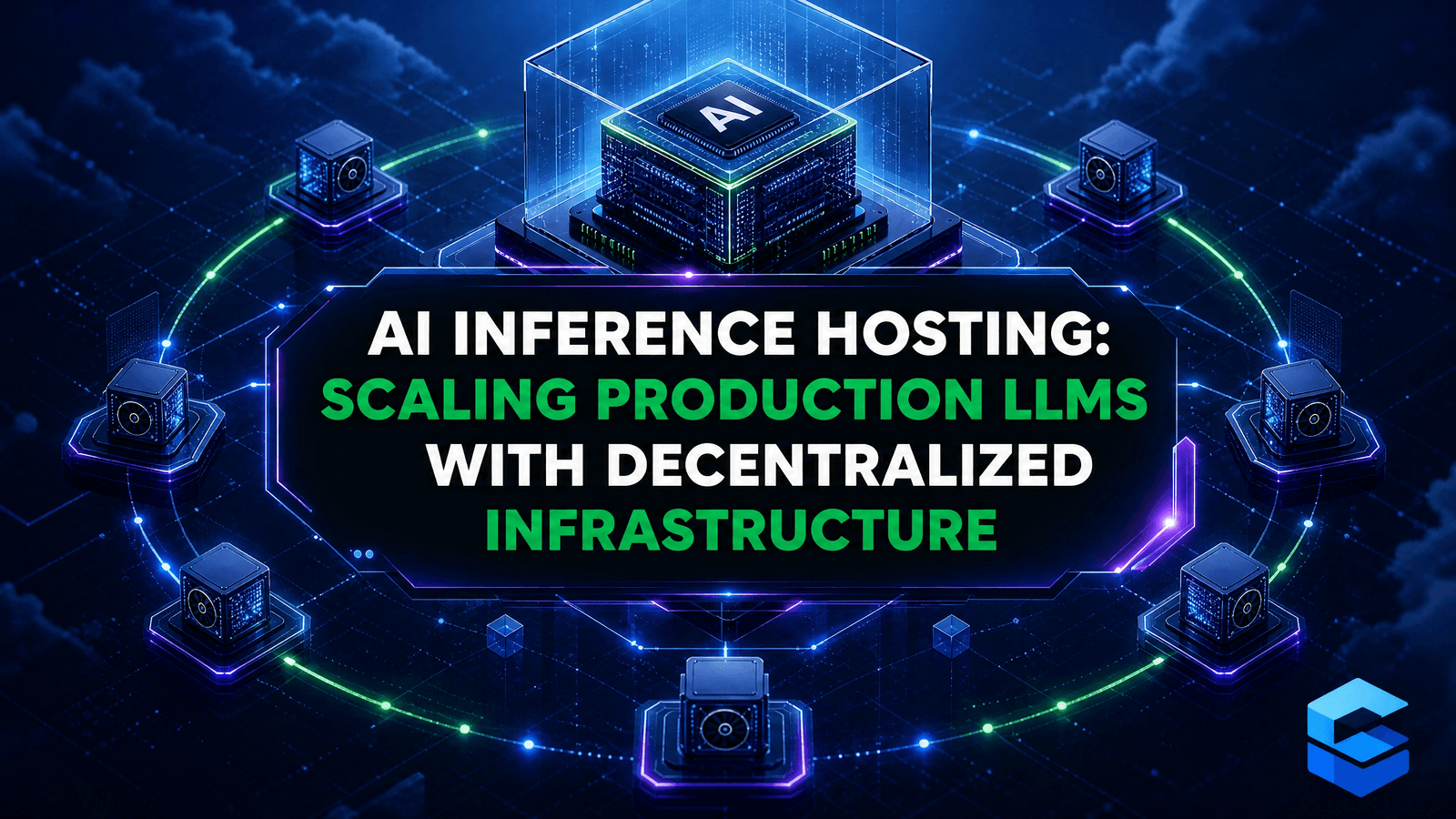
Learn how AI inference hosting scales production LLMs and how decentralized GPU infrastructure improves performance, flexibility, and cost efficiency with CapaCloud.
TL;DR
- AI inference hosting provides the infrastructure needed to deploy and serve AI models with low latency, high availability, and scalable performance.
- Production LLMs require GPU infrastructure that can handle real-time requests, fluctuating workloads, and growing user demand.
- Decentralized GPU infrastructure improves resource availability, reduces infrastructure bottlenecks, and offers a scalable alternative to traditional cloud environments.
- Optimizing AI inference through techniques such as autoscaling, model optimization, and efficient GPU utilization improves performance while reducing costs.
- CapaCloud enables organizations to deploy and scale AI inference workloads using decentralized, on-demand GPU infrastructure designed for production AI applications.
Large language models (LLMs) are transforming everything from customer support and software development to healthcare and financial services.
However, building or fine-tuning a model is only part of the journey. Once a model is ready, it needs infrastructure that can deliver fast, reliable responses to users at scale. That’s where AI inference hosting becomes essential.
Modern AI applications, including chatbots, RAG systems, and enterprise AI assistants, need infrastructure that can deliver fast, reliable performance at scale. That’s why many organizations are moving beyond traditional cloud environments to gain greater flexibility and cost efficiency.
In this guide, you’ll learn what AI inference hosting is, how it works, the challenges of scaling production LLMs, and why decentralized GPU infrastructure is becoming a popular choice for modern AI deployments. You’ll also discover how platforms like CapaCloud make it easier to scale AI inference with flexible, on-demand GPU resources built for production workloads.
Table of Contents
- TL;DR
- What Is AI Inference Hosting?
- Common AI Inference Workloads
- How AI Inference Hosting Works
- Challenges of Scaling AI Inference
- Traditional Cloud vs Decentralized AI Inference Hosting
- Best Practices for Cost-Effective AI Inference
- Why Organizations Choose CapaCloud for AI Inference
- FAQs
- Final Thoughts On AI Inference Hosting
What Is AI Inference Hosting?
AI inference hosting is the process of deploying a trained AI model on computing infrastructure so applications can send inputs and receive predictions or generated outputs.
For an LLM, an inference request generally involves:
- Receiving a prompt or API request.
- Validating and preprocessing the request.
- Scheduling the request for model execution.
- Loading or accessing model weights and runtime state.
- Executing the model on GPU or other suitable hardware.
- Generating output tokens.
- Streaming or returning the response.
- Recording operational and performance metrics.
Inference is different from training.
Training changes the model’s parameters using a dataset. Inference uses an already-trained model to produce an output for new input.
AI Training vs. AI Inference
| AI training | AI inference |
| Updates model parameters | Uses existing model parameters |
| Usually compute-intensive batch workloads | Often serves continuous requests |
| Requires training datasets | Requires incoming application data |
| Optimized around training throughput | Optimized around latency, throughput and cost |
| May run periodically | Can operate continuously in production |
| Often requires tightly coordinated multi-GPU infrastructure | Can range from one GPU to large distributed serving fleets |
The distinction matters because infrastructure optimized for training is not necessarily optimal for inference.
A production inference system needs to respond to unpredictable traffic while maintaining an acceptable service level.
Common AI Inference Workloads
AI inference hosting can support:
- LLM chat applications
- AI assistants and copilots
- Retrieval-Augmented Generation (RAG)
- Code-generation systems
- Document summarization
- Classification and extraction
- Recommendation systems
- Image generation
- Speech recognition and synthesis
- Translation
- Computer-vision applications
The infrastructure requirements differ substantially between these workloads.
A batch image-generation workload, for example, can often tolerate higher latency than an interactive coding assistant. An enterprise RAG application may prioritize predictable response times, while a background document-processing system may prioritize throughput and cost.
That means there is no single “best” inference GPU or hosting architecture.
How AI Inference Hosting Works
AI inference hosting ensures trained AI models are available to process requests in real time. Every time someone interacts with an AI chatbot, generates an image, or asks an AI assistant a question, the hosting infrastructure receives the request, processes it using GPU resources, and returns a response within seconds or even milliseconds. A well-designed inference platform keeps this process fast, reliable, and scalable as demand grows.
Model Deployment
A trained AI model is deployed to GPU-powered infrastructure, where it remains ready to handle incoming requests. Unlike training, the model isn’t rebuilt each time it’s used. Instead, it’s continuously available to serve users.
Processing User Requests
When a user sends a prompt through an application or API, the request is routed to an inference server. The server assigns the workload to an available GPU, where the model processes the input and generates a response before sending it back to the application.
Scaling and Monitoring
As more users interact with the application, the hosting platform automatically adjusts GPU resources to maintain performance. At the same time, monitoring tools track important metrics such as:
- GPU utilization
- Response latency
- Request throughput
- System health
This combination of automation and monitoring helps ensure AI applications remain responsive, even during periods of high demand.
AI Inference Workflow
A typical inference request follows this sequence:
- A user sends a request through an application or API.
- The request is routed to an inference server.
- An available GPU processes the request.
- The AI model generates a response.
- The response is returned to the user.
- Resources are monitored and scaled as demand changes.
Platforms like CapaCloud simplify this process by providing on-demand access to decentralized GPU resources, allowing organizations to scale AI inference without managing dedicated GPU infrastructure.
Challenges of Scaling AI Inference
Deploying an AI model is one thing. Scaling it to support thousands of users while maintaining speed, reliability, and cost efficiency is another. As AI adoption grows, organizations face several infrastructure challenges.
Limited GPU Availability
High-performance GPUs are in high demand, making it difficult to secure additional capacity when workloads increase. This often results in:
- Limited GPU availability
- Longer provisioning times
- Slower scaling
Rising Infrastructure Costs
Serving AI models around the clock can quickly become expensive, especially when GPU resources are underutilized.
Common cost drivers include:
- Idle GPU resources
- Overprovisioned infrastructure
- Long-running inference workloads
- Peak-demand pricing
Maintaining Performance at Scale
As workloads grow, AI applications must continue delivering fast, reliable responses. This requires infrastructure that can:
- Minimize latency
- Scale automatically with demand
- Maintain high availability
- Deliver consistent performance across regions
These challenges are driving organizations toward decentralized GPU infrastructure as a more flexible and efficient way to scale AI inference. Platforms like CapaCloud help address these challenges by providing on-demand access to distributed GPU resources that can adapt as production workloads grow.
Traditional Cloud vs Decentralized AI Inference Hosting
Choosing the right infrastructure plays a major role in the performance, scalability, and cost of AI inference. While traditional cloud providers remain a popular choice, decentralized GPU infrastructure is becoming an increasingly attractive option for organizations looking to scale production AI workloads more efficiently.
The biggest difference lies in how GPU resources are accessed and managed. Traditional cloud platforms rely on centralized data centers, whereas decentralized infrastructure connects distributed GPU resources through a shared network. This approach can improve resource availability, reduce idle hardware, and provide greater flexibility as demand changes.
| Feature | Traditional Cloud Infrastructure | Decentralized GPU Infrastructure |
| GPU availability | Limited by regional capacity | Access to distributed GPU resources |
| Scalability | Dependent on cloud capacity | Flexible scaling across distributed networks |
| Infrastructure costs | Often includes premium pricing and idle resources | Pay for resources as needed |
| Geographic coverage | Limited to provider regions | Distributed across multiple locations |
| Vendor lock-in | Higher dependency on a single provider | Greater infrastructure flexibility |
| Resource utilization | Idle GPUs may remain unused | Better utilization of available GPU resources |
| Reliability | Dependent on centralized infrastructure | Distributed architecture improves resilience |
Traditional cloud infrastructure is still a strong choice for organizations with predictable workloads or existing cloud ecosystems. However, businesses running AI applications with fluctuating demand often require more flexibility than centralized infrastructure can provide.
Decentralized GPU infrastructure offers a more flexible way to scale AI inference as demand grows. Platforms like CapaCloud provide on-demand access to distributed GPU resources, helping organizations improve scalability while keeping infrastructure costs under control
Best Practices for Cost-Effective AI Inference
Scaling AI inference isn’t just about adding more GPUs. The most successful AI deployments focus on using compute resources efficiently while maintaining fast, reliable performance. A few practical strategies can significantly reduce infrastructure costs without compromising the user experience.
Choose the Right GPU for the Workload
Not every AI model requires the most powerful GPU available. Matching the GPU to the model’s size and workload helps prevent unnecessary infrastructure costs while maintaining the performance needed for production inference.
Optimize Models Before Deployment
Optimizing models for inference reduces the amount of compute required to generate responses. Techniques such as quantization, model compression, and pruning can improve inference speed while lowering GPU resource consumption.
Scale Resources Automatically
AI workloads often fluctuate throughout the day. Autoscaling ensures GPU resources increase during peak demand and scale back when activity decreases, helping organizations avoid paying for unused infrastructure.
Improve GPU Utilization
Keeping GPUs busy is one of the most effective ways to reduce costs. Organizations can improve utilization by:
- Batching similar inference requests
- Distributing workloads efficiently across available GPUs
- Eliminating idle compute resources
- Monitoring GPU performance continuously
Adopt Flexible Infrastructure
Long-term GPU provisioning isn’t always the most economical approach, especially for organizations with changing workloads. Pay-per-use infrastructure allows businesses to access compute resources only when they’re needed, improving cost efficiency while providing the flexibility to scale as demand grows.
Decentralized GPU platforms like CapaCloud support this model by giving organizations on-demand access to distributed GPU resources, making it easier to optimize infrastructure costs while maintaining the performance required for production AI inference.
Why Organizations Choose CapaCloud for AI Inference
As AI applications grow, so do the demands placed on the infrastructure that powers them. Organizations need GPU resources that can scale quickly, remain cost-effective, and deliver consistent performance without the complexity of managing large GPU clusters. This is where platforms like CapaCloud provide a practical alternative to traditional cloud infrastructure.
Built on a decentralized GPU marketplace, CapaCloud gives developers, AI startups, and enterprises access to on-demand GPU resources for production AI workloads. Instead of investing in dedicated hardware or overprovisioning cloud infrastructure, organizations can scale compute resources as their inference needs evolve.
Built for Production AI Workloads
Production AI requires infrastructure that can keep pace with growing demand. CapaCloud is designed to support workloads such as:
- Large language model (LLM) inference
- AI chatbots and virtual assistants
- Retrieval-Augmented Generation (RAG) applications
- Image and multimedia generation
- Enterprise AI applications
- High-performance computing (HPC) workloads
Scale Without Overprovisioning
One of the biggest challenges with traditional infrastructure is paying for GPU capacity that isn’t always in use. CapaCloud addresses this by providing access to GPU resources when they’re needed, allowing organizations to scale workloads without maintaining excess infrastructure.
This approach helps businesses:
- Respond to changing demand more efficiently
- Improve GPU utilization
- Reduce infrastructure waste
- Optimize operational costs
Flexible Infrastructure for Growing AI Applications
AI workloads rarely remain static. New users, larger models, and expanding applications all place greater demands on infrastructure. CapaCloud’s decentralized architecture provides the flexibility to adapt to these changing requirements, making it easier to support production AI as it grows.
A Smarter Approach to AI Inference Hosting
Choosing an AI inference hosting platform is about more than GPU performance. The right platform should provide the flexibility to scale, the reliability to support production workloads, and the efficiency to keep infrastructure costs under control.
By combining decentralized GPU infrastructure with on-demand resource access, CapaCloud helps organizations deploy and scale AI inference workloads without the limitations often associated with traditional cloud environments. Whether you’re launching a new AI application or expanding an existing one, CapaCloud provides a scalable foundation for delivering fast, reliable AI experiences.
FAQs
What is AI inference hosting?+
AI inference hosting is the infrastructure that deploys and serves trained AI models in production. It enables applications to process user requests, generate predictions or responses, and deliver results in real time. Unlike AI training, which builds the model, inference hosting focuses on making the model available for everyday use.
What is the difference between AI training and AI inference?+
AI training is the process of teaching a model using large datasets so it can recognize patterns and make accurate predictions. AI inference is what happens after training, when the model uses what it has learned to respond to new inputs. Training is typically a one-time or periodic task, while inference runs continuously as users interact with AI applications.
Can businesses self-host AI inference models?+
Yes, businesses can self-host AI inference models using their own GPU infrastructure. However, managing hardware, scaling resources, ensuring uptime, and maintaining performance can become complex and expensive as workloads grow. Many organizations choose managed or decentralized infrastructure to simplify operations and scale more efficiently.
How can organizations reduce AI inference costs?+
Organizations can lower inference costs by optimizing AI models, matching GPU resources to workload requirements, implementing autoscaling, batching inference requests, and avoiding overprovisioned infrastructure. Using flexible, pay-per-use GPU resources can also help reduce unnecessary spending while maintaining performance.
Why choose CapaCloud for AI inference hosting?+
CapaCloud provides access to decentralized, on-demand GPU infrastructure that helps organizations deploy and scale production AI workloads more efficiently. By connecting users to distributed GPU resources, the platform offers greater flexibility, improved resource utilization, and the ability to scale AI inference without relying solely on traditional cloud infrastructure.
Final Thoughts On AI Inference Hosting
As AI adoption continues to accelerate, serving models efficiently has become just as important as building them. The right AI inference hosting infrastructure can improve application performance, support growing user demand, and help organizations control infrastructure costs without sacrificing reliability.
As production AI workloads become more demanding, flexible infrastructure will play an increasingly important role in delivering consistent, high-quality AI experiences.
If you’re looking for a more scalable way to deploy production AI workloads, platforms like CapaCloud offer a modern alternative to traditional cloud infrastructure. Explore CapaCloud‘s decentralized GPU marketplace to access on-demand GPU resources that help you scale AI inference with greater flexibility, efficiency, and cost control.