
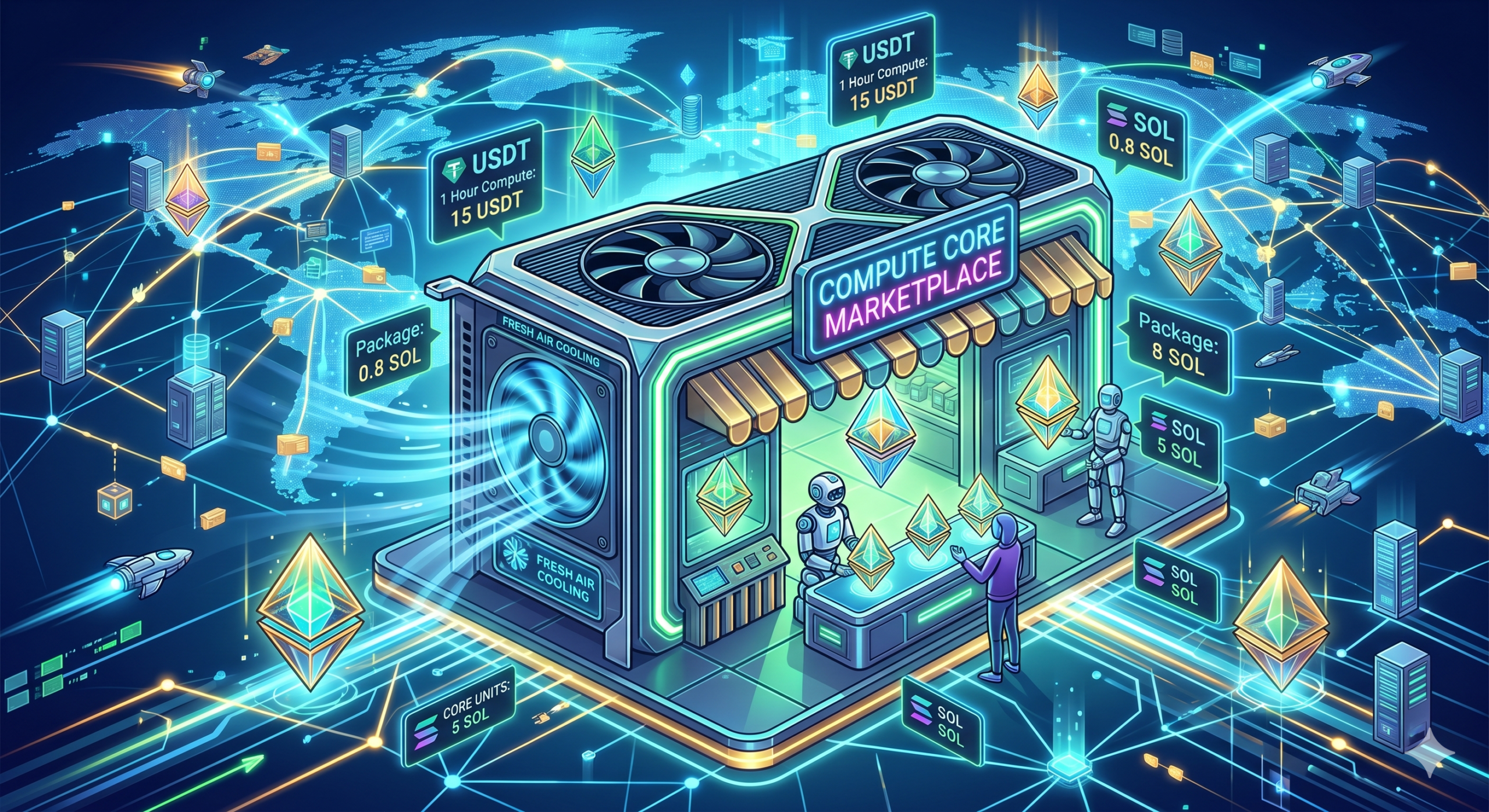
Explore the best GPU compute marketplace platforms in 2026. Compare pricing, features, and use cases, including CapaCloud, and learn how decentralized GPU clouds are transforming AI infrastructure.
Key takeaways
- GPU compute marketplaces are becoming a core layer of AI infrastructure, unlocking access to global, distributed GPU supply
- Platforms like CapaCloud enable significantly lower costs through dynamic pricing and idle resource utilization
- Blockchain-based coordination introduces transparent pricing, automated payments, and new trust mechanisms in decentralized compute
- Performance and reliability still vary, making hybrid strategies with traditional cloud providers the most practical approach today
- The long-term shift is toward a more open, market-driven “neocloud” model where compute is sourced globally rather than owned centrally
GPU compute is no longer just another cloud resource. It has become one of the most constrained and valuable inputs in modern software. What used to be a specialized tool for graphics or niche workloads is now the backbone of artificial intelligence, powering everything from large language models to real-time recommendation systems.
The demand curve has shifted dramatically. AI models are getting larger, requiring more memory, more parallelism, and longer training cycles. At the same time, inference is moving into real time, where applications need fast, always-available compute to serve users instantly. This creates a dual pressure on infrastructure. High-performance GPUs are needed both for building models and for running them continuously in production.
As a result, startups and enterprises are competing for the same limited pool of GPUs. Even well-funded teams face delays, allocation limits, or unpredictable pricing when trying to scale. Traditional cloud providers still dominate the market, but they come with tradeoffs. Costs are high, availability can be constrained during peak demand, and access is controlled by centralized allocation systems.
This is where GPU compute marketplaces begin to change the equation.
Instead of relying on a single provider, these platforms aggregate GPU supply from across the world and make it accessible on demand. Idle GPUs in data centers, research labs, and even individual machines can be pooled together into a unified marketplace. This shifts compute from a scarce, centrally controlled resource into something closer to a global commodity.
In 2026, the most important evolution is not just aggregation. It is coordination. Blockchain-based GPU marketplaces introduce a new way to manage trust, pricing, and execution across distributed networks. Payments can be automated and transparent. Pricing can adjust dynamically based on supply and demand. Workloads can be verified without relying on a single central authority.
The result is a new model for compute. One that is more open, more flexible, and increasingly aligned with how modern AI systems are built and deployed.
What Is a GPU Compute Marketplace
A GPU compute marketplace is a coordination layer that brings together two sides of the same problem:
- Suppliers who have idle or underutilized GPU capacity
- Users who need compute for workloads like AI training, inference, rendering, or data processing
At its core, the marketplace functions like an exchange for compute. Instead of buying or reserving infrastructure upfront, users can tap into a shared pool of GPUs on demand. This pool can include anything from enterprise-grade hardware in data centers to smaller clusters operated by independent providers.
What makes this model powerful is that it unlocks stranded capacity. Across the world, a large percentage of GPUs sit idle at any given time. Marketplaces turn that unused supply into accessible, monetizable infrastructure.
Unlike traditional cloud platforms, most GPU marketplaces do not own the hardware themselves. They act as an orchestration and coordination layer. Their job is to:
- Discover available GPU resources
- Match them with incoming workloads
- Handle scheduling and execution
- Facilitate payments and trust between participants
This fundamentally changes the economics of compute. Instead of a few centralized providers controlling supply and pricing, the market becomes more competitive and dynamic.
How GPU Marketplaces Work
The workflow is straightforward but powerful:
- Providers list GPUs with specs like A100, H100, or RTX-class cards
- Developers submit jobs such as model training or batch inference
- A matching engine assigns workloads based on price, availability, and performance
- Jobs run in containerized environments, usually via Docker or Kubernetes
- Results are verified using redundancy or reputation systems
- Payments are settled automatically, often through smart contracts
This model reduces friction while opening access to global compute supply.
GPU Pricing in 2026
Cost is one of the biggest reasons teams switch to marketplaces.
Typical ranges in 2026:
- A100 GPUs: roughly $0.80 to $2.50 per hour depending on demand
- H100 GPUs: often $2.50 to $6.00 per hour
- RTX-class GPUs: as low as $0.20 to $0.80 per hour
Compared to traditional cloud providers, this can mean:
- 40 to 70 percent lower costs for non-critical workloads
- Better pricing flexibility through spot or bidding models
The tradeoff is variability. Lower cost often comes with less predictability.
Key Features of Top GPU Marketplace Platforms
The strongest platforms share a few core traits:
- Global GPU aggregation across independent providers
- Dynamic pricing based on real-time supply and demand
- On-demand scaling without long provisioning delays
- Developer-friendly APIs and SDKs
- Verification systems to ensure job correctness
- Incentive models that reward uptime and reliability
Platform Comparison
Here is a practical comparison of how leading GPU marketplace platforms position themselves in 2026:
| Platform | Type | Pricing Model | Best For | Key Strength |
| CapaCloud | Peer-to-peer neocloud | Dynamic | General AI workloads | Global GPU aggregation |
| Decentralized Network A | Fully decentralized | Bidding | Cheapest compute | Low cost access |
| Hybrid Platform B | Hybrid | Fixed + spot | Enterprise workloads | Reliability |
| AI Network C | Specialized | Usage-based | Inference | Optimized latency |
Top Platform Analysis
CapaCloud
Overview
CapaCloud is part of a new generation of GPU compute platforms often described as “neocloud” infrastructure. Instead of relying on centrally owned data centers, it aggregates GPU capacity from a distributed network of providers and presents it as a unified, on-demand marketplace for developers.
The platform is designed to feel closer to a modern cloud experience while still benefiting from decentralized supply. This makes it accessible to teams that want cost advantages without dealing with the full complexity of raw peer-to-peer systems.
At a high level, CapaCloud focuses on bridging two gaps. First, it unlocks global GPU supply that would otherwise remain idle. Second, it simplifies access to that supply through developer-friendly tooling and orchestration.
Key Features
- Peer-to-peer GPU sourcing
- Intelligent workload routing
- Flexible pricing models
- Clean developer experience
Best For
Teams that want a balance between cost efficiency and usability.
Strengths
- Strong alignment with decentralized compute trends
- Access to globally distributed GPUs
- Flexible for both training and inference
Limitations
- Dependent on network growth for maximum scale
- Still maturing compared to hyperscalers
GPU Marketplace vs AWS, Azure, and GCP
Understanding the tradeoffs is critical.
Traditional Cloud Providers
- High reliability and uptime guarantees
- Strong support for enterprise workloads
- Expensive GPU pricing
- Limited flexibility
GPU Marketplaces
- Lower cost through competition
- Access to idle global capacity
- Flexible pricing models
- More variability in performance
In practice, most teams are moving toward a hybrid approach.
Technical Considerations
Before choosing a platform, it is important to understand the technical constraints.
GPU Types
Not all workloads run on all GPUs. Training large models may require A100 or H100 clusters.
Containerization
Most platforms rely on Docker or Kubernetes, so workloads must be container-ready.
Data Transfer
Large datasets can become a bottleneck. Data locality matters.
Multi-Node Training
Distributed training is still challenging on decentralized networks due to latency.
Fault Tolerance
Jobs may fail more often than on hyperscalers, so retry logic is essential.
How Verification Works
Trust is one of the hardest problems in decentralized compute.
Common approaches include:
- Redundant execution where jobs are run multiple times
- Reputation systems that score providers based on performance
- Deterministic workloads where outputs can be verified
- Emerging proof-of-compute systems
No solution is perfect yet, but the space is improving quickly
Use Cases
GPU marketplaces are already being used in practical ways:
- Fine-tuning large language models
- Running Stable Diffusion or image generation pipelines
- Batch inference for recommendation systems
- Rendering for animation and 3D projects
- Scientific simulations that require burst compute
These are workloads where cost matters more than perfect reliability.
Benefits of GPU Compute Marketplaces
- Significant cost savings
- Access to otherwise unused GPU capacity
- Faster scaling for experimental workloads
- Reduced dependence on a single vendor
- More open and flexible infrastructure
When You Should Not Use a GPU Marketplace
GPU marketplaces are not always the right choice.
Avoid them for:
- Mission-critical production systems that require strict uptime
- Ultra-low latency applications
- Highly regulated environments with strict compliance needs
In these cases, traditional cloud providers are still the safer option.
Future of GPU Compute Marketplaces in 2026
Several forces are driving rapid growth:
- Increasing demand for AI training and inference
- Expansion of real-time AI applications
- Improvements in verification systems
- Enterprise experimentation with hybrid infrastructure
- Deeper integration into AI development workflows
How to Choose the Right Platform
Choosing the right marketplace depends on your priorities:
- For training: prioritize performance and GPU availability
- For inference: focus on latency and cost
- For experimentation: optimize for price and flexibility
- For production: consider hybrid approaches
A good strategy is to start small, test workloads, and scale gradually.
The Bigger Shift: From Cloud to Neocloud
GPU marketplaces are part of a broader transition toward distributed infrastructure.
Instead of relying only on centralized hyperscalers, compute is becoming:
- More open
- More distributed
- More market-driven
This shift is often described as the rise of neocloud, where coordination replaces ownership as the primary model.
FAQ
What is the cheapest GPU cloud option in 2026
In most cases, decentralized GPU marketplaces offer the lowest cost. Because they aggregate idle GPUs from across the world, pricing is driven by competition rather than fixed rates. This often leads to significantly lower prices compared to traditional cloud providers.
For example, spot-style pricing and bidding systems allow users to access GPUs at a fraction of typical cloud costs, especially for flexible workloads. However, the cheapest option usually comes with tradeoffs such as variable performance, limited guarantees, or longer job wait times. For non-critical tasks like experimentation, batch processing, or model fine-tuning, these platforms are often the most cost-effective choice.
Can I rent GPUs for AI training
Yes, renting GPUs for AI training is one of the primary use cases for these platforms. Most GPU marketplaces support common machine learning frameworks and allow you to run training jobs in containerized environments.
That said, there are a few practical considerations. Single-node training is widely supported and works well. Multi-node or distributed training can be more complex due to network latency and coordination challenges across geographically distributed machines. Some platforms are improving in this area, but it is still less seamless than on traditional cloud providers.
For best results, many teams start with smaller training jobs or fine-tuning workloads before scaling up.
How do marketplaces handle failed jobs
GPU marketplaces typically use a combination of mechanisms to deal with failures.
The most common approach is automatic retries, where failed jobs are rescheduled on another available GPU. Some platforms also use redundancy, running the same job on multiple nodes to compare results and ensure correctness.
In addition, provider reputation systems play an important role. Nodes that consistently fail jobs or produce incorrect results are penalized or deprioritized, while reliable providers are rewarded with more work.
From a user perspective, it is still important to design workloads with fault tolerance in mind, including checkpointing and restart strategies.
Are GPU marketplaces secure
Security depends on the platform, but most modern GPU marketplaces implement several layers of protection.
Workloads are typically executed in isolated environments using containers, which helps prevent interference between jobs. Data is often encrypted in transit, and some platforms offer additional safeguards such as secure enclaves or restricted execution environments.
Verification systems also add a layer of trust by ensuring that results are valid and have not been tampered with. However, because these are distributed systems, they may not yet meet the strictest compliance requirements found in highly regulated industries.
For sensitive workloads, it is important to review each platform’s security model and consider hybrid approaches.
Can enterprises use GPU marketplaces
Yes, and many already are, but usually in a hybrid setup.
Enterprises often use GPU marketplaces for cost-sensitive or non-critical workloads such as experimentation, batch inference, or overflow capacity during peak demand. At the same time, they continue to rely on traditional cloud providers for mission-critical systems that require strict uptime, compliance, and support guarantees.
This hybrid approach allows organizations to reduce costs and increase flexibility without compromising reliability. As marketplaces mature and improve their infrastructure, their role in enterprise environments is expected to grow significantly.
Conclusion
GPU compute marketplaces are no longer experimental. They are becoming a practical and increasingly necessary layer in the modern infrastructure stack.
As demand for AI continues to accelerate, the limitations of traditional cloud providers are becoming more visible. Cost, availability, and flexibility are no longer small concerns. They are critical constraints. GPU marketplace address these challenges by unlocking global supply and introducing more competitive, dynamic pricing models.
Platforms like CapaCloud show how this shift is taking shape. By combining distributed infrastructure with developer-friendly tooling, they make it easier to access compute without being locked into a single provider.
That said, this is not a complete replacement for traditional cloud. Reliability, consistency, and enterprise readiness still matter, and centralized providers continue to play an important role. The direction is clearly toward a hybrid model, where teams use marketplaces for flexibility and cost efficiency, while relying on hyperscalers for critical workloads.
What is changing is the balance of power. Compute is becoming more open, more distributed, and more market-driven.
For teams building in 2026 and beyond, the question is no longer whether to use GPU marketplaces. It is how to integrate them effectively into your stack.